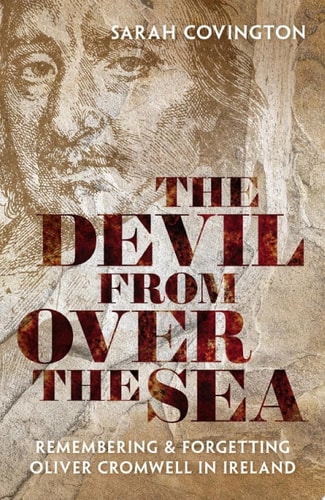
The Devil from over the Sea: Remembering and Forgetting Oliver Cromwell in Ireland
0
0
As an Amazon Associate and affiliate partner, Menrva Books earns from qualifying purchases. Learn more
Author Description
In Ireland, few figures have generated more hatred than Oliver Cromwell, whose seventeenth-century conquest, massacres, and dispossessions would endure in the social memory for ages to come. The Devil from over the Sea explores the many ways in which Cromwell was remembered and sometimes conveniently 'forgotten' in historical, religious, political, and literary texts, according to the interests of different communities across time. Cromwell's powerful afterlife in Ireland, however, cannot be understood without also investigating his presence in folklore and the landscape, in ruins and curses. Nor can he be separated from the idea of the 'Cromwellian': a term which came to elicit an entire chain of contemptuous associations that would begin after his invasion and assume a wholly new force in the nineteenth century. What emerges from all these memorializing traces is a multitudinous Cromwell who could be represented as brutal, comic, sympathetic, or satanic. He could be discarded also, tellingly, from the accounts of the past, and especially by those which viewed him as an embarrassment or worse. In addition to exploring the many reasons why Cromwell was so vehemently remembered or forgotten in Ireland, Sarah Covington finally uncovers the larger truths conveyed by sometimes fanciful or invented accounts. Contrary to being damaging examples of myth-making, the memorializations contained in martyrologies, folk tales, or newspaper polemics were often productive in cohering communities, or in displaying agency in the form of 'counter-memories' that claimed Cromwell for their own and reshaped Irish history in the process.
Menrva's Summary
THE THESIS
How does the figure of Oliver Cromwell function as a malleable construct within Irish social memory, and what does the persistent act of remembering or forgetting him reveal about the communities that invoke his name? Sarah Covington, a historian specializing in early modern Britain and Ireland, utilizes a diverse array of primary sources—ranging from folklore and ruins to political polemics—to argue that the 'Cromwellian' is not a static historical fact but a fluid symbol. She demonstrates that the various iterations of Cromwell, whether satanic or sympathetic, serve as vital tools for community cohesion and the assertion of political agency across centuries of Irish history.
THE SCOPE MAP
What You Will Find
- Analysis of seventeenth-century conquest narratives and their evolution into the nineteenth century.
- Examination of folklore, oral traditions, and physical landscape markers as repositories of memory.
- Investigation of 'counter-memories' used by disparate groups to reshape historical identity.
Scope Limits
- The text does not provide a comprehensive military biography of Cromwell's life outside of his Irish campaign.
- It does not focus on contemporary British political historiography, remaining strictly centered on the Irish reception of the figure.
THE AUTHORITY PERSPECTIVE
Scholars recognize this work as a significant contribution to the field of memory studies, noting its ability to bridge the gap between formal historical documentation and the more ephemeral nature of folklore. Readers frequently highlight the depth of the research and the author's skill in navigating the complex, often contradictory, layers of Irish historical consciousness.
Page Count:
419
Publication Date:
2022-01-01
Publisher:
OUP Oxford
ISBN-10:
0192587676
ISBN-13:
9780192587671
History
Biography
Memory Studies
Political History
Irish History
Cultural History
History of the Americas
Great Britain
Community Tags
Similar Books