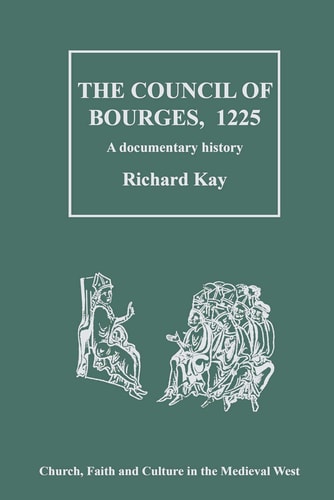
The Council of Bourges, 1225: A Documentary History
0
0
As an Amazon Associate and affiliate partner, Menrva Books earns from qualifying purchases. Learn more
Author Description
Never before had France had a church council so large: almost 1000 churchmen assembled at Bourges on 29 November 1225 to authorize a tax on their incomes in support of the Second Albigensian Crusade. About one third of the participants were representatives sent by corporate bodies, in accordance with a new provision of canon law that insisted, for the first time ever, that there should be no taxation without representation. Basing himself on the rich surviving records, Professor Kay paints a skilful portrait of this council: the political manoeuvering by the papal legate to ensure the tax went through, and his use of this highly public occasion to humiliate members of the University of Paris; and, on the other hand, his failure to win a permanent endowment to support the papal bureaucracy, the bishops' effective protests against the pope's threat to diminish their jurisdiction over monasteries, and a subsequent 'taxpayers' revolt' that challenged the validity of the tax. The book also draws out the importance and implications of what took place, highlighting the council's place at the fountainhead of European representative democracy, the impact of the decisions made on the course of the Albigensian Crusade, the reform of monasticism, and the funding of the papal government which was left to rely on stop-gap expedients, such as the sale of indulgences. In addition, the author suggests that the corpus of texts, newly edited from the original manuscripts and with English translation, could be seen as a model for the revision of the conciliar corpus, most of which still remains based on 18th-century scholarship.
Menrva's Summary
THE THESIS
The Council of Bourges in 1225 convened nearly 1000 churchmen to authorize a tax for the Second Albigensian Crusade, marking a significant moment in medieval ecclesiastical and political history. Richard Kay's work, based on surviving records, details the complex political maneuvering by the papal legate to secure the tax, his humiliation of the University of Paris, and his ultimate failure to establish a permanent endowment for the papal bureaucracy. The book also explores the bishops' successful protests against the pope's infringement on their monastic jurisdiction and a subsequent 'taxpayers' revolt' that questioned the tax's legitimacy. Kay argues for the council's importance as a precursor to European representative democracy and analyzes its impact on the Albigensian Crusade, monastic reform, and papal government funding.
THE SCOPE MAP
- Analysis of the political strategies employed by the papal legate to gain support for the crusade tax.
- Examination of the 'no taxation without representation' principle as applied to church income in the 13th century.
- Details on the protests and challenges raised by bishops regarding papal authority over monasteries.
- Exploration of the 'taxpayers' revolt' and its implications for the council's decisions.
- Discussion of the council's role in the development of European representative democracy.
- Assessment of the impact of the council's decisions on the Albigensian Crusade and monastic reform.
- Consideration of the council's influence on the funding of the papal government.
- Presentation of newly edited texts from original manuscripts with English translations.
THE AUTHORITY PERSPECTIVE
This documentary history is recognized for its detailed examination of a pivotal medieval church council, highlighting its significance in the development of representative democracy and its impact on the Albigensian Crusade. The author's use of newly edited primary source texts provides a rich foundation for his analysis of the political and ecclesiastical dynamics at play. The work is noted for its scholarly depth, offering insights into the challenges of papal taxation and the assertion of episcopal authority in the 13th century.
Page Count:
620
Publication Date:
2002-05-31
Publisher:
Routledge
ISBN-10:
0754608034
ISBN-13:
9780754608035
History
Non-Fiction
European History
Political History
Religious History
Church History
Community Tags
Similar Books