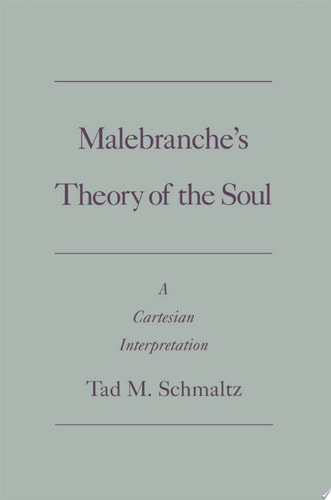
Malebranche's Theory of the Soul: A Cartesian Interpretation
0
0
As an Amazon Associate and affiliate partner, Menrva Books earns from qualifying purchases. Learn more
Author Description
When French philosopher Nicolas Malebranche (1638-1715) set forth his opposition to Descartes' view that mind is better known than body, he touched off a controversy that had prominent fellow Cartesians accusing him of both failed logic and dubious theology. Malebranche responded by asserting that his negative thesis concerning our knowledge of mind derived from his superior grasp of Cartesian theory and signalled neither a rejection of Descartes' philosophical system nor a denial of properties of the soul such as spirituality, immortality, and freedom. The current resurgence of interest in Malebranche's work has led to a greater understanding of his account of ideas, his notorious doctrine of "the Vision of all things in God," but has left unexplored crucial aspects of his theory of the soul and the precise nature of its Cartesianism. This vital new book confronts these matters directly, arguing provocatively that Malebranche was correct in claiming a Cartesian foundation for his theory and demonstrating the value to Cartesian studies of Malebranche's uniquely internal critique of Descartes' account of body and mind.
Menrva's Summary
THE THESIS
Does Nicolas Malebranche’s theory of the soul represent a coherent extension of Cartesian philosophy or a departure from its core tenets? Tad M. Schmaltz, a scholar specializing in early modern philosophy, examines the historical controversy surrounding Malebranche’s rejection of the Cartesian claim that the mind is better known than the body. By analyzing primary texts and the intellectual climate of the seventeenth century, Schmaltz argues that Malebranche’s account of the soul remains fundamentally rooted in Cartesian principles despite contemporary accusations of theological and logical error.
THE SCOPE MAP
What You Will Find
- An analysis of the debate between Malebranche and his Cartesian contemporaries regarding the nature of the mind.
- A detailed examination of the doctrine of the Vision of all things in God.
- Philosophical arguments concerning the soul’s spirituality, immortality, and freedom within the Cartesian framework.
- A critical assessment of Malebranche’s internal critique of Descartes’ dualism.
THE AUTHORITY PERSPECTIVE
Scholars recognize this work as a significant contribution to the study of early modern metaphysics and the evolution of Cartesian thought. Readers frequently note the academic density of the prose, which is intended for advanced students and researchers in the field of philosophy.
Page Count:
320
Publication Date:
1996-09-05
Publisher:
Oxford University Press
ISBN-10:
0195103440
ISBN-13:
9780195103441
Philosophy
Epistemology
Soul
Cartesianism
Metaphysics
Community Tags
Similar Books