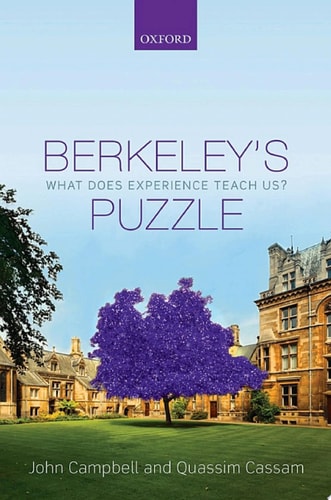
Berkeley's Puzzle: What Does Experience Teach Us?
0
0
As an Amazon Associate and affiliate partner, Menrva Books earns from qualifying purchases. Learn more
Author Description
Sensory experience seems to be the basis of our knowledge and conception of mind-independent things. The puzzle is to understand how that can be: even if the things we experience (apples, tables, trees, etc), are mind-independent how does our sensory experience of them enable us to conceive of them as mind-independent? George Berkeley thought that sensory experience can only provide us with the conception of mind-dependent things, things which cannot exist when they aren't being perceived. It's easy to dismiss Berkeley's conclusion but harder to see how to avoid it. In this book, John Campbell and Quassim Cassam propose very different solutions to Berkeley's Puzzle. For Campbell, sensory experience can be the basis of our knowledge of mind-independent things because it is a relation, more primitive than thought, between the perceiver and high-level objects and properties in the mind-independent world. Cassam opposes this 'relationalist' solution to the Puzzle and defends a 'representationalist' solution: sensory experience can give us the conception of mind-independent things because it represents its objects as mind-independent, but does so without presupposing concepts of mind-independent things. This book is written in the form of a debate between two rival approaches to understanding the relationship between concepts and sensory experience. Although Berkeley's Puzzle frames the debate, the questions addressed by Campbell and Cassam aren't just of historical interest. They are among the most fundamental questions in philosophy.
Menrva's Summary
THE THESIS
This book investigates the fundamental philosophical problem of how sensory experience allows humans to conceive of objects as existing independently of the mind. The authors, John Campbell and Quassim Cassam, utilize the historical framework of George Berkeley’s idealism to challenge contemporary theories of perception. They present two distinct philosophical arguments—relationalism and representationalism—to explain the bridge between sensory input and the conceptualization of an objective, mind-independent world.
THE SCOPE MAP
What You Will Find
- A structured debate between relationalist and representationalist theories of perception.
- Analysis of George Berkeley’s arguments regarding mind-dependent versus mind-independent existence.
- Philosophical inquiry into the relationship between sensory experience and conceptual thought.
Scope Limits
- The text does not provide a comprehensive history of all theories of perception.
- It does not address neuroscientific or biological mechanisms of sensory processing.
THE AUTHORITY PERSPECTIVE
Experts identify this work as a significant contribution to contemporary philosophy of perception, particularly for its clear articulation of the tension between relational and representational views. Readers frequently note the academic density of the prose, which is intended for those with a background in analytic philosophy.
Page Count:
224
Publication Date:
2014-01-01
Publisher:
OUP Oxford
ISBN-10:
0191025550
ISBN-13:
9780191025556
Philosophy
Epistemology
Mind & Body
Perception
Metaphysics
Academic
Experience
Community Tags
Similar Books