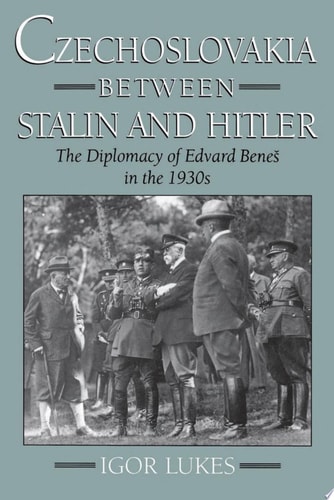
Czechoslovakia between Stalin and Hitler: The Diplomacy of Edvard Beneš in the 1930s
0
0
As an Amazon Associate and affiliate partner, Menrva Books earns from qualifying purchases. Learn more
Author Description
The Munich crisis of 1938, in which Great Britain and France decided to appease Hitler's demands to annex the Sudentenland, has provoked a vast amount of historical writing. But historians have had, until now, only a vague understanding of the roles played by the Soviet Union and by Czechoslovakia, the country whose very existence was at the center of the crisis.In Czechoslovakia Between Stalin and Hitler, Igor Lukes explores this turbulent and tragic era from the new perspective of the Prague government itself. At the center of this study is Edvard Benes, a Czechoslovak foreign policy strategist and a major player in the political machinations of the era. The work analyzes the Prague Government's attempts to secure the existence of the Republic of Czechoslovakia in the treacherous space between the millstones of the East and West. It studies Benes's relationship with Joseph Stalin, outlines the role assigned to Czechoslovak communists by the VIIth Congress of the Communist International in 1935, and dissects Prague's secret negotiations with Berlin and Benes's role in the famous Tukhachevsky affair. Using secret archives in both Prague and Russia, this work is an accurate and original rendition of the events that sparked the Second World War.
Menrva's Summary
THE THESIS
This work investigates how the Czechoslovak government under Edvard Beneš navigated the existential threat posed by the competing interests of Nazi Germany and the Soviet Union during the 1930s. Igor Lukes, a specialist in Central European history, utilizes previously classified archival materials from Prague and Moscow to reconstruct the diplomatic landscape of the pre-war era. The study examines the strategic calculations of the Prague government as it attempted to maintain national sovereignty while caught between the expansionist policies of Hitler and the geopolitical maneuvering of Stalin. By focusing on the specific actions of Beneš, the text provides a detailed analysis of the diplomatic failures and secret negotiations that preceded the Munich crisis.
THE SCOPE MAP
What You Will Find
- Detailed analysis of the 1938 Munich crisis and the subsequent collapse of the Czechoslovak Republic.
- Examination of the diplomatic relationship between Edvard Beneš and Joseph Stalin.
- Investigation into the Tukhachevsky affair and its impact on Czechoslovak-Soviet relations.
- Primary source evidence derived from secret archives in Prague and Russia.
- Assessment of the VIIth Congress of the Communist International and its influence on Czechoslovak internal politics.
THE AUTHORITY PERSPECTIVE
Historians and scholars of European diplomacy recognize this text as a critical contribution to understanding the internal decision-making processes of the Czechoslovak government during the interwar period. Readers frequently note the academic density of the prose and the author's meticulous use of archival evidence to challenge traditional narratives of the Munich crisis.
Page Count:
352
Publication Date:
1996-05-23
Publisher:
Oxford University Press
ISBN-10:
0195102665
ISBN-13:
9780195102666
History
Diplomatic History
European History
Military History
Community Tags
Other Editions(2)
Similar Books