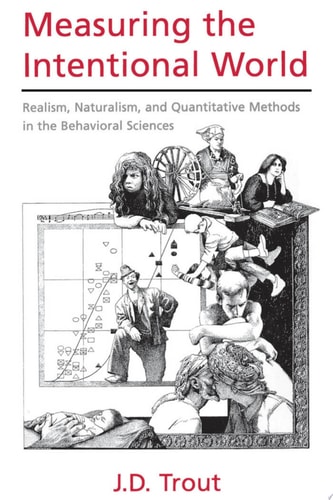
Measuring the Intentional World: Realism, Naturalism, and Quantitative Methods in the Behavioral Sciences
0
0
As an Amazon Associate and affiliate partner, Menrva Books earns from qualifying purchases. Learn more
Author Description
Scientific realism has been advanced as an interpretation of the natural sciences but never the behavioral sciences. Using as evidence the advances in the psychological and social sciences over the last 100 years, J. D. Trout develops a novel version of realism - Measured Realism - required to characterize a form of theoretical progress in the behavioral sciences that is uneven but indisputable. Assimilating estimation to a familiar epistemic category, Measuring the Intentional World proposes an innovative theory of measurement - Population-Guided Estimation - that connects natural, psychological, and social scientific inquiry. The philosophical defense of this naturalism requires a pattern of reasoning no stronger or more controversial than that used by scientists themselves. The role of Population-Guided Estimation is then illustrated in disputes about the methodological reliability of narrative psychoanalysis, narrative history, significance testing, triangulation, and deference to experts. Presenting quantitative methods in the behavioral sciences as at once successful and regulated by the world, Measuring the Intentional World will engage philosophers of science, and scientists interested in the foundations of their own disciplines.
Menrva's Summary
THE THESIS
This book investigates whether scientific realism can be applied to the behavioral sciences through a new framework of measurement. J. D. Trout, a philosopher of science, argues that the behavioral sciences have achieved genuine theoretical progress that is often overlooked. By drawing on a century of psychological and social science data, he introduces 'Measured Realism' and 'Population-Guided Estimation' to bridge the gap between natural and behavioral scientific inquiry.
THE SCOPE MAP
What You Will Find
- A theoretical framework for 'Measured Realism' in behavioral research
- The methodology of 'Population-Guided Estimation' for scientific inquiry
- Critical analysis of narrative psychoanalysis and narrative history
- Evaluation of significance testing, triangulation, and expert deference
THE AUTHORITY PERSPECTIVE
Experts in the philosophy of science view this work as a significant contribution to the foundations of behavioral research. Readers frequently note the academic density of the prose, which is intended for scholars and scientists interested in the methodological underpinnings of their disciplines.
Page Count:
304
Publication Date:
1998-02-05
Publisher:
Oxford University Press
ISBN-10:
0195107667
ISBN-13:
9780195107661
Science
Philosophy
Psychology
Realism
Statistical methods
Methodology
Sociology