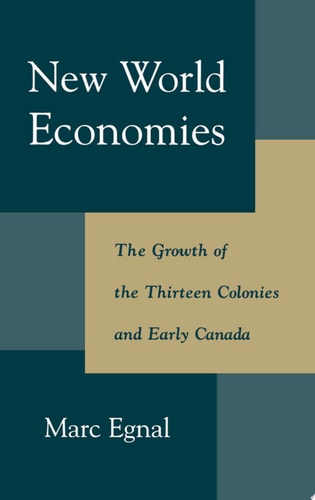
New World Economies: The Growth of the Thirteen Colonies and Early Canada
0
0
As an Amazon Associate and affiliate partner, Menrva Books earns from qualifying purchases. Learn more
Author Description
New World Economies: The Growth of the Thirteen Colonies and Early Canada examines the economic development of both the original American colonies and early French Canada, looking at the impact of changing prices, capital flows, and shifts in demand. It is a companion volume to Marc Egnal's well-regarded earlier book, Divergent Paths, which emphasized the influence of culture and institutions upon growth. New World Economies studies transatlantic ties and sets forth a rigorous model to explain the pattern of growth. It features seventeen tables and more than one hundred graphs, many of which are based on original data. Several appendices present these valuable new statistics.Egnal's core argument is that the pace of economic development in the colonies reflected the rate of growth in the mother country. In advancing this central notion, the book employs a theoretical foundation that builds upon, and then moves beyond, the traditional "staple thesis." Thoroughly documented and rich in quantitative data, this study traces the trajectory of economic growth by region and establishes a clear connection between colonial and European rates of growth.Given its clear arguments, its rich data, and its persuasive overall method, New World Economies will interest scholars and students of economic history, of American and French-Canadian colonial culture, and of transatlantic relations during the eighteenth century.
Menrva's Summary
THE THESIS
This work investigates the primary drivers of economic development in the Thirteen Colonies and early French Canada during the eighteenth century. Marc Egnal, a historian specializing in colonial economic systems, utilizes a quantitative framework to challenge traditional interpretations of colonial growth. By analyzing capital flows, price fluctuations, and demand shifts, Egnal argues that colonial economic expansion was fundamentally tethered to the growth rates of their respective European mother countries.
THE SCOPE MAP
What You Will Find
- Comparative analysis of economic development in the Thirteen Colonies and French Canada
- A theoretical model that expands upon the traditional staple thesis
- Quantitative data sets including seventeen tables and over one hundred original graphs
- Appendices containing primary statistical evidence regarding transatlantic trade and growth
THE AUTHORITY PERSPECTIVE
Scholars and students of economic history frequently cite this work for its rigorous quantitative methodology and its clear, data-driven arguments. Experts highlight the text as a significant contribution to the study of transatlantic relations and colonial development patterns.
Page Count:
256
Publication Date:
1998-11-12
Publisher:
Oxford University Press
ISBN-10:
0195114825
ISBN-13:
9780195114829
Economics
History
Canada
Economic History
Colonial History
Community Tags
Similar Books