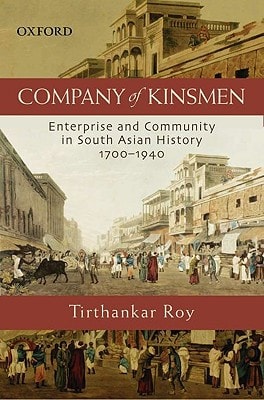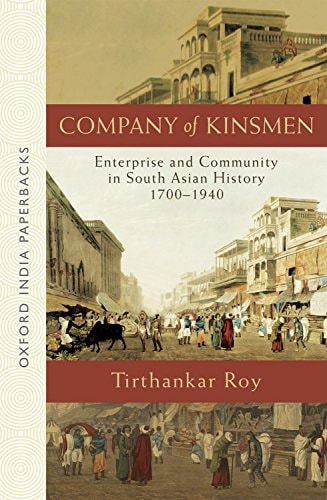
Company of Kinsmen: Enterprise and Community in South Asian History 1700-1940
0
0
As an Amazon Associate and affiliate partner, Menrva Books earns from qualifying purchases. Learn more
Author Description
This book chronicles how the concept of organizing people to serve economic ends emerged in early modern and colonial India. It examines rules of cooperation, why people decided to join forces, how disputes were settled, and how cooperative communities became increasingly unstable in more modern times. It focuses on five dimensions: actor, agent, time, purpose, and region. The leading actors are peasants, labourers, artisans, merchants/bankers, and the states. The rules of cooperation that formed inside communities of merchants and others were respected by the states. However, these rules would eventually become unstable due to the integration of India within a global-industrial economy and the introduction of a new rule of law in the old guise of "custom". As a result, the endogamous guild, a kind of collective that used marriage rules to secure cooperative ties, became weaker, to be supplanted by other forms of organization. Collectives controlled property, managed resources, supplied training, and conducted negotiations. The regional angle is important because regions differed on the composition of enterprise, and globalization and colonialism unfolded unevenly across space. The book presents an economic history of institutional change in South Asia.
Menrva's Summary
THE THESIS
This book investigates the evolution of economic cooperation and organizational structures in South Asia from 1700 to 1940. Tirthankar Roy, a prominent economic historian, utilizes archival research and institutional analysis to examine how traditional social collectives, such as endogamous guilds, facilitated economic activity. He argues that the integration of India into the global industrial economy and the imposition of colonial legal frameworks fundamentally destabilized these indigenous cooperative systems, leading to their eventual decline and replacement by modern organizational forms.
THE SCOPE MAP
What You Will Find
- Analysis of economic cooperation among peasants, artisans, and merchants.
- Examination of the role of endogamous marriage rules in securing business ties.
- Comparative study of regional variations in enterprise across colonial India.
- Evaluation of the impact of global trade and colonial law on traditional institutions.
THE AUTHORITY PERSPECTIVE
Scholars recognize this work as a significant contribution to the economic history of India, particularly for its focus on the intersection of social structure and market behavior. Readers frequently note the academic density of the prose and the author's rigorous approach to institutional change.
Page Count:
268
Publication Date:
2018-06-19
Publisher:
Oxford University Press
ISBN-10:
0199486808
ISBN-13:
9780199486809
Economics
History
South Asia
Colonial History
Economic History
Industrial Policy