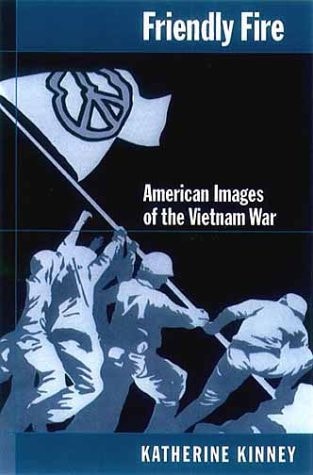
Friendly Fire: American Images of the Vietnam War
0
0
As an Amazon Associate and affiliate partner, Menrva Books earns from qualifying purchases. Learn more
Author Description
Hundreds of memoirs, novels, plays, and movies have been devoted to the American war in Vietnam. In spite of the great variety of mediums, political perspectives and the degrees of seriousness with which the war has been treated, Katherine Kinney argues that the vast majority of these works share a single story: that of Americans killing Americans in Vietnam. Friendly Fire, in this instance, refers not merely to a tragic error of war, it also refers to America's war with itself during the Vietnam years. Starting from this point, this book considers the concept of "friendly fire" from multiple vantage points, and portrays the Vietnam age as a crucible where America's cohesive image of itself is shattered--pitting soldiers against superiors, doves against hawks, feminism against patriarchy, racial fear against racial tolerance. Through the use of extensive evidence from the film and popular fiction of Vietnam (i.e. Kovic's Born on the Fourth of July, Didion's Democracy, O'Brien's Going After Cacciato, Rabe's Sticks and Bones and Streamers), Kinney draws a powerful picture of a nation politically, culturally, and socially divided, and a war that has been memorialized as a contested site of art, media, politics, and ideology.
Menrva's Summary
THE THESIS
Katherine Kinney investigates whether the diverse body of American cultural production regarding the Vietnam War is unified by a singular, recurring narrative of internal self-destruction. Drawing on her academic expertise, Kinney analyzes a wide array of memoirs, novels, plays, and films to argue that the concept of "friendly fire" serves as a central metaphor for the era's profound domestic discord. She posits that the war functioned as a crucible that fractured American identity, exposing deep-seated conflicts between competing social, political, and cultural factions.
THE SCOPE MAP
What You Will Find
- Analysis of cultural artifacts including literature, film, and popular media from the Vietnam era.
- Examination of the "friendly fire" metaphor as a tool for understanding national self-conflict.
- Case studies of specific works such as Ron Kovic's "Born on the Fourth of July" and Tim O'Brien's "Going After Cacciato."
- Exploration of thematic tensions including racial dynamics, gender roles, and the divide between military and civilian perspectives.
THE AUTHORITY PERSPECTIVE
Scholars and critics recognize this work as a significant contribution to the study of how the Vietnam War continues to shape American cultural memory. Readers frequently note the academic rigor of the text, which provides a structured framework for interpreting the complex relationship between historical trauma and artistic representation.
Page Count:
240
Publication Date:
2000-11-02
Publisher:
Oxford University Press
ISBN-10:
0195116038
ISBN-13:
9780195116038
History
Vietnam War
Film Studies
American Studies
National characteristics American
Criticism history
War stories
In literature
Literary Criticism
Community Tags
Similar Books