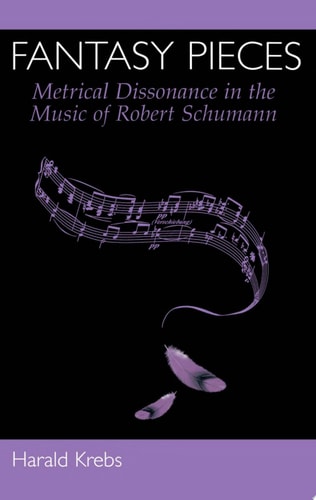
Fantasy Pieces: Metrical Dissonance in the Music of Robert Schumann
0
0
As an Amazon Associate and affiliate partner, Menrva Books earns from qualifying purchases. Learn more
Author Description
Fantasy Pieces examines from several vantage points a vital life-force of Robert Schumann's music, namely metrical conflict. Harald Krebs's imaginative yet rigorous study makes use of Schumann's fascinating projections of his own personality--the characters Florestan and Eusebius--as one means of addressing the biographical and aesthetic context of the music.In counterpoint with the remarks of these personae, Krebs develops an original theory of metrical conflict by adapting the concepts of consonance and dissonance to metrical analysis. He investigates how states of metrical dissonance arise, and shows how they are manipulated and resolved in the course of compositions. He offers new methods for understanding the metrical progressions of entire works or movements, and studies the interaction of metrical conflict with form, with pitch structure, and with the texts of Schumann's vocal works. Krebs includes a wealth of illustrations from the whole range of Schumann's work and offers numerous insights important for performance. In the final chapter, he provides richly detailed studies of pieces by Schumann in various genres, interspersing them with shorter discussions of music by Berlioz, Chopin, Clara Schumann, Ives, and Schoenberg.This is a book that will appeal not only to students and scholars of music theory, but to all musicians interested in the life, work, and unique personality of Robert Schumann.
Menrva's Summary
THE THESIS
How does the concept of metrical dissonance function as a primary expressive force within the compositions of Robert Schumann? Harald Krebs, a noted musicologist, utilizes a framework that bridges biographical context with technical music theory. By adopting Schumann's own literary alter egos, Florestan and Eusebius, as analytical lenses, Krebs constructs a rigorous method for identifying and resolving metrical conflicts across the composer's diverse body of work.
THE SCOPE MAP
What You Will Find
- A theoretical framework applying the concepts of consonance and dissonance to metrical analysis.
- Detailed examination of metrical progressions in Schumann's vocal and instrumental works.
- Comparative studies involving works by Berlioz, Chopin, Clara Schumann, Ives, and Schoenberg.
- Practical insights regarding the interaction between metrical conflict, pitch structure, and musical form.
THE AUTHORITY PERSPECTIVE
Experts and music scholars frequently cite this work as a foundational text for understanding the rhythmic complexity of 19th-century Romantic music. Readers often note the academic density of the prose, which provides a sophisticated analytical toolkit for both performers and theorists.
Page Count:
304
Publication Date:
1999-02-25
Publisher:
Oxford University Press
ISBN-10:
0195116232
ISBN-13:
9780195116236
Biography
Music theory
Music Analysis
Musicology