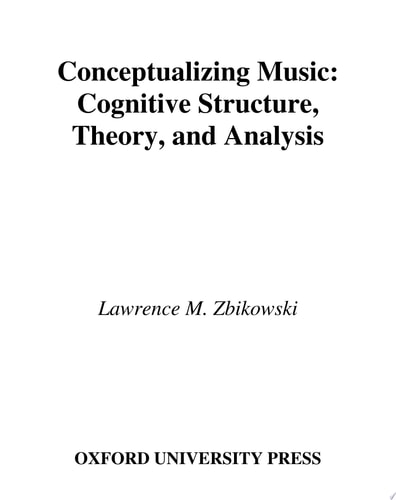
Conceptualizing Music: Cognitive Structure, Theory, and Analysis
0
0
As an Amazon Associate and affiliate partner, Menrva Books earns from qualifying purchases. Learn more
Author Description
This Book Shows How Recent Work In Cognitive Science, Especially That Developed By Cognitive Linguists And Cognitive Psychologists, Can Be Used To Explain How We Understand Music. The Book Focuses On Three Cognitive Processes--categorization, Cross-domain Mapping, And The Use Of Conceptual Models--and Explores The Part These Play In Theories Of Musical Organization. The First Part Of The Book Provides A Detailed Overview Of The Relevant Work In Cognitive Science, Framed Around Specific Musical Examples. The Second Part Brings This Perspective To Bear On A Number Of Issues With Which Music Scholarship Has Often Been Occupied, Including The Emergence Of Musical Syntax And Its Relationship To Musical Semiosis, The Problem Of Musical Ontology, The Relationship Between Words And Music In Songs, And Conceptions Of Musical Form And Musical Hierarchy. The Book Will Be Of Interest To Music Theorists, Musicologists, And Ethnomusicologists, As Well As Those With A Professional Or Avocational Interest In The Application Of Work In Cognitive Science To Humanistic Principles.
Menrva's Summary
THE THESIS
This book investigates how principles from cognitive science, specifically cognitive linguistics and psychology, provide a framework for understanding the structural and semantic organization of music. Lawrence M. Zbikowski, a scholar in music theory, synthesizes interdisciplinary research to argue that human cognitive processes—categorization, cross-domain mapping, and conceptual modeling—are fundamental to how listeners perceive and interpret musical form. By applying these cognitive tools to traditional musicological problems, the author establishes a bridge between humanistic inquiry and empirical cognitive science.
THE SCOPE MAP
What You Will Find
- An overview of cognitive science theories applied to musical perception.
- Analysis of musical syntax and its relationship to musical semiosis.
- Examination of conceptual models in musical hierarchy and form.
- Investigation into the relationship between lyrics and musical structure in songs.
THE AUTHORITY PERSPECTIVE
Experts in musicology and cognitive science recognize this work as a foundational text for understanding the intersection of music theory and cognitive linguistics. Readers frequently note the academic density of the prose, which requires a strong background in music theory to fully grasp the proposed analytical frameworks.
Page Count:
376
Publication Date:
2002-01-01
Publisher:
Ebsco Publishing
ISBN-10:
019803217X
ISBN-13:
9780198032175
Psychology
Music Analysis
Musicology
Cognition
Music theory