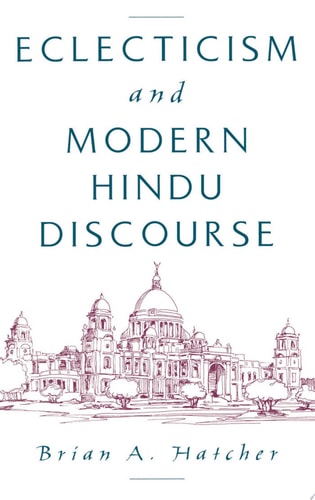
Eclecticism and Modern Hindu Discourse
0
0
As an Amazon Associate and affiliate partner, Menrva Books earns from qualifying purchases. Learn more
Author Description
In this new book, Brian Hatcher examines the modern Hindu penchant for constructing religious worlds in an eclectic fashion. Noting how Hindu apologists from Rammohun Roy to Sarvepalli Radhakrishnan make an almost promiscuous use of the world's many philosophies and religions to define and defend Hinduism, Hatcher sets out to explore the ancient roots and contemporary significance of such eclectic borrowing. A discussion of the Vedic and classical roots of Hindu eclecticism affords Hatcher the opportunity to reflect upon the profound and widespread role of eclecticism in South Asian religion, while consideration of the work of Swami Vivekananda--as well as a variety of religious reformers from nineteenth-century Bengal--suggests the ongoing significance of the phenomenon in colonial and postcolonial contexts.By examining the development of Brahmo and Neo-Vedanta discourse, Hatcher is able both to problematize the notion of a monolithic concept of religious eclecticism and to reflect upon the various ways scholars might nevertheless attempt to make sense of a bewildering variety of eclectic philosophies. What emerges is not simply an attempt to refine our understanding of the role eclecticism has played in the modern Hindu context, but an extended reflection upon changing attitudes toward eclecticism in the West, from Diderot and Kant through postmodern critical theory. By investigating modern and postmodern perspectives on such issues as history, system, authenticity, and difference, Hatcher seeks to set in motion a dialectical approach to the study of eclectic world construction that balances the positivisitic confidence of modern scholarship with the playful exuberance of postmodern pastiche. Invoking the critical theories of Salman Rushdie, Theodor Adorno, and Richard Rorty, Hatcher advocates an approach to modern Hindu eclecticism that honors its creative poetics while retaining the critical distance necessary for judging its sometimes baleful fruits.
Menrva's Summary
THE THESIS
This book investigates the historical development and contemporary significance of eclecticism as a central strategy in modern Hindu religious discourse. Brian A. Hatcher, a scholar of South Asian religions, utilizes a comparative framework to analyze how Hindu reformers from the nineteenth century to the present have synthesized diverse philosophical and religious traditions to define their faith. By contrasting classical Vedic roots with colonial and postcolonial adaptations, Hatcher argues that this eclectic borrowing is not merely a byproduct of modernity but a deliberate, creative, and often critical mode of world-building.
THE SCOPE MAP
What You Will Find
- Historical analysis of Hindu reformers including Rammohun Roy, Sarvepalli Radhakrishnan, and Swami Vivekananda.
- Examination of Brahmo and Neo-Vedanta discourse within nineteenth-century Bengal.
- Comparative theoretical engagement with Western thinkers such as Diderot, Kant, Adorno, and Rorty.
- A dialectical methodology that balances modern academic positivism with postmodern critical theory.
THE AUTHORITY PERSPECTIVE
Scholars in the field of religious studies recognize this work as a rigorous contribution to the understanding of modern Hindu intellectual history. Readers frequently note the academic density of the prose and the author's sophisticated application of critical theory to traditional religious texts.
Page Count:
216
Publication Date:
1999-05-13
Publisher:
Oxford University Press
ISBN-10:
019512538X
ISBN-13:
9780195125382
Religion
Philosophy
Hinduism
History of Ideas
Community Tags
Other Editions(2)
Similar Books

Reader Comments
Share Your Thoughts
No comments yet. Be the first to share your thoughts!