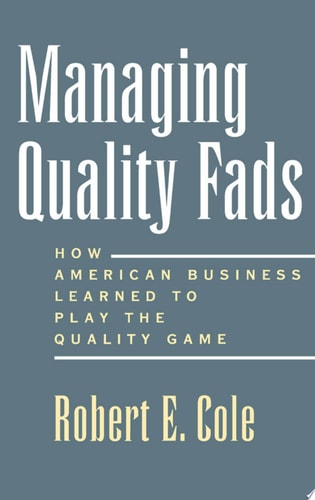
Managing Quality Fads: How American Business Learned to Play the Quality Game
0
0
As an Amazon Associate and affiliate partner, Menrva Books earns from qualifying purchases. Learn more
Author Description
Can managers learn from fads? That is the question Robert Cole addresses in this insightful book about the various factors supporting and inhibiting organizational learning.A longtime student of the Japanese and American quality movements, Cole focuses on the response of American industry to the challenge posed in the early 1980s by high quality goods from Japan. While most American managers view this challenge as slowly but successfully met, many academics see the quality movement that emerged from it as just another fad. In seeking to reconcile these two views, Cole explores the reasons behind American industry's slow response to Japanese quality, arguing that a variety of institutional factors inhibited management action in the early 1980s. He then describes the reshaping of institutions that allowed American companies to close the quality gap and to achieve sustained quality improvements in the 1990s.Hewlett-Packard serves as an example of a company that made this institutional transition more effectively than most. Cole describes Hewlett-Packard's successful strategies while also pointing out the serious problems that it and other companies face as they attempt to adapt, improve, and go beyond Japanese practices. He also uses Hewlett-Packard, an exemplar of the highly decentralized company, to explore effective strategies for the creation, dissemination, and implementation of knowledge.Unprecedented as a scholarly treatment of the quality movement,Managing Quality Fads provides several important lessons for those interested in management decision making under conditions of uncertainty and organizational transformation in a rapidly changing business environment.
Menrva's Summary
THE THESIS
This book investigates whether organizational learning can occur through the adoption of management fads, specifically focusing on the American response to the quality movement. Robert E. Cole, a long-term observer of Japanese and American industrial practices, utilizes historical analysis and organizational theory to examine the institutional barriers that hindered American firms in the early 1980s. He argues that the eventual success of American companies in closing the quality gap was not merely a result of adopting new techniques, but rather a fundamental reshaping of internal institutional structures.
THE SCOPE MAP
What You Will Find
- Analysis of the institutional factors that inhibited American management during the 1980s.
- A detailed case study of Hewlett-Packard as a model for decentralized organizational learning.
- Examination of the tension between academic skepticism of management fads and practitioner success.
- Strategies for the creation, dissemination, and implementation of knowledge within large corporations.
THE AUTHORITY PERSPECTIVE
Experts recognize this work as a significant scholarly contribution to the study of the quality movement and corporate adaptation. Readers frequently note that the text provides a balanced, analytical perspective that moves beyond simple management advice to address the complexities of organizational transformation.
Page Count:
304
Publication Date:
1999-02-04
Publisher:
Oxford University Press
ISBN-10:
0195122607
ISBN-13:
9780195122602
Business
Industrial history
Corporate Strategy
Management
Quality Control
Community Tags
Similar Books