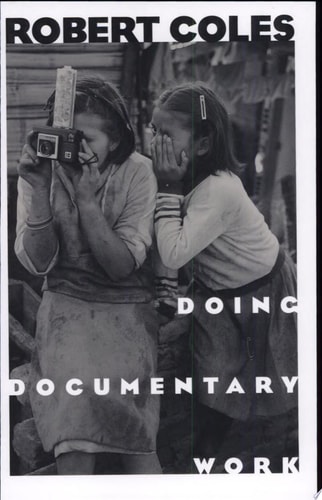
Doing Documentary Work
0
0
As an Amazon Associate and affiliate partner, Menrva Books earns from qualifying purchases. Learn more
Author Description
Sitting in his study, William Carlos Williams once revealed to Robert Coles what he considered to be his greatest problem in writing a documentary about his patients in New Jersey. "When I'm there, sitting with those folks, listening and talking," he said to Coles, "I'm part of that life, and I'm near it in my head, too.... Back here, sitting near this typewriter--its different. I'm a writer. I'm a doctor living in Rutherford who is describing 'a world elsewhere.'" Williams captured the great difficulty in documentary writing--the gulf that separates the reality of the subject from the point of view of the observer.Now, in this thought-provoking volume, the renowned child psychiatrist Robert Coles, author of the Pulitzer Prize-winning Children in Crisis series, offers a penetrating look into the nature of documentary work. Utilizing the documentaries of writers, photographers, and others, Coles shows how their prose and pictures are influenced by the observer's frame of reference: their social and educational background, personal morals, and political beliefs. He discusses literary documentaries: James Agee's searching portrait of Depression-era tenant farmers, Let Us Now Praise Famous Men, and George Orwell's passionate description of England's coal-miners, The Road to Wigan Pier. Like many documentarians, Coles argues, Agee and Orwell did not try to be objective, but instead showered unadulterated praise on the "noble" poor and vituperative contempt on the more privileged classes (including themselves) for "exploiting" these workers. Documentary photographs could be equally revealing about the observer. Coles analyzes how famous photographers such as Walker Evans and Dorthea Lange edited and cropped their pictures to produce a desired effect. Even the shield of the camera could not hide the presence of the photographer. Coles also illuminates his points through his personal portraits of William Carlos Williams; Robert Moses, one of the leaders of the Student Non-V
Menrva's Summary
THE THESIS
This volume investigates the inherent tension between the objective reality of a subject and the subjective perspective of the observer in documentary work. Robert Coles, a renowned child psychiatrist and author, draws upon his extensive experience in social observation and his analysis of seminal documentary works to argue that all documentation is filtered through the creator's personal, social, and political framework. By examining the methodologies of writers and photographers, Coles demonstrates that the act of recording reality is an interpretive process rather than a neutral one.
THE SCOPE MAP
What You Will Find
- Analysis of literary documentaries including works by James Agee and George Orwell.
- Examination of photographic techniques used by Walker Evans and Dorothea Lange.
- Discussion of the influence of personal morals, class background, and political beliefs on observational work.
- Case studies involving personal portraits and the ethical challenges of representing the lives of others.
THE AUTHORITY PERSPECTIVE
Experts and readers recognize this text as a foundational exploration of the ethics and mechanics of documentary observation. The prose is noted for its accessibility while maintaining a high level of intellectual rigor regarding the subjective nature of human documentation.
Page Count:
288
Publication Date:
1998-11-19
Publisher:
New York Public Library
ISBN-10:
0195124952
ISBN-13:
9780195124958
Non-Fiction
Photography
Humanities
Literary Criticism
Sociology
Community Tags
Similar Books