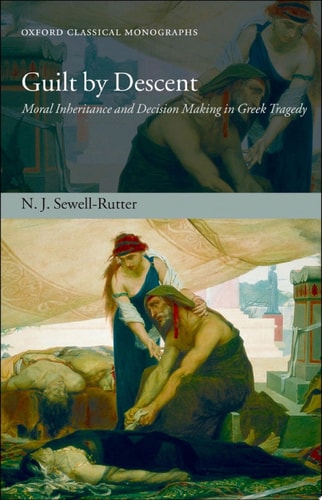
Guilt by Descent: Moral Inheritance and Decision Making in Greek Tragedy
0
0
As an Amazon Associate and affiliate partner, Menrva Books earns from qualifying purchases. Learn more
Author Description
Blighted and accursed families are an inescapable feature of Greek tragedy, and many scholars have treated questions of inherited guilt, curses, and divine causation. N.J. Sewell-Rutter gives these familiar issues a fresh appraisal, arguing that tragedy is a medium that fuses the conceptual with the provoking and exciting of emotion, neither of which can be ignored if the texts are to be fully understood. He pays particular attention to Aeschylus' Seven against Thebes and the Phoenician Women of Euripides, both of which dramatize the sorrows of the later generations of the House of Oedipus, but in very different, and perhaps complementary, ways. All Greek quotations are translated, making his study thoroughly accessible to the non-specialist reader.
Menrva's Summary
THE THESIS
This work investigates how the concept of inherited guilt functions as a mechanism for moral decision-making within the framework of Greek tragedy. N. J. Sewell-Rutter, a scholar of classical literature, challenges traditional interpretations of curses and divine causation by proposing that tragedy serves as a bridge between abstract conceptualization and emotional engagement. He argues that the internal logic of these plays requires an analysis that balances theological fatalism with the psychological agency of the characters.
THE SCOPE MAP
What You Will Find
- Comparative analysis of Aeschylus' Seven against Thebes and Euripides' Phoenician Women
- Examination of the House of Oedipus as a case study for generational trauma
- Methodological approach integrating emotional response with intellectual inquiry
Scope Limits
- Does not provide a comprehensive survey of all extant Greek tragedies
- Focuses primarily on the specific thematic intersection of inheritance and moral choice rather than broader historical context
THE AUTHORITY PERSPECTIVE
Scholars frequently note the accessibility of this text due to the inclusion of translated Greek quotations, making it suitable for non-specialists. Experts highlight the work as a nuanced contribution to the study of tragic agency and the mechanics of inherited moral burdens.
Page Count:
236
Publication Date:
2010-01-01
Publisher:
OUP Oxford
ISBN-10:
019161548X
ISBN-13:
9780191615481
Philosophy
Drama
History
Greek drama
Humanities
Literary Criticism
Criticism history
Ethics
Theatre
Ancient History
Special Topics
Greek Tragedy
Community Tags
Other Editions(2)
Similar Books