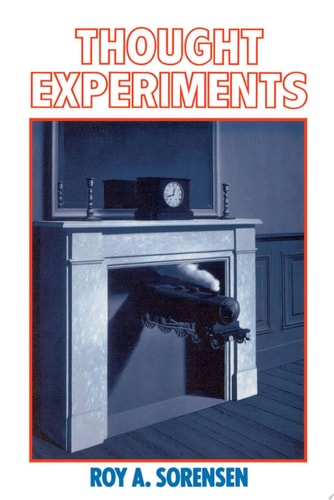
Thought Experiments
0
0
As an Amazon Associate and affiliate partner, Menrva Books earns from qualifying purchases. Learn more
Author Description
Can merely thinking about an imaginary situation provide evidence for how the world actually is--or how it ought to be? In this lively book, Roy A. Sorensen addresses this question with an analysis of a wide variety of thought experiments ranging from aesthetics to zoology. Presenting the first general theory of thought experiment, he sets it within an evolutionary framework and integrates recent advances in experimental psychology and the history of science, with special emphasis on Ernst Mach and Thomas Kuhn.Sorensen explores what thought experiments are, how they work, and what their virtues and vices are. In his view, philosophy differs from science in degree, but not in kind. For this reason, he claims, it is possible to understand philosophical thought experiments by concentrating on their resemblance to scientific relatives. Sorensen assesses the hazards of thought experiments and grants that there are interesting ways in which the method leads us astray, but attacks most scepticism about thought experiments as arbitrary. He maintains that they should be used--as they generally are--as part of a diversified portfolio of techniques, creating a network of cross-checks that make for impressive reliability.
Menrva's Summary
THE THESIS
Can the process of imagining hypothetical scenarios yield genuine evidence regarding the nature of the physical world or normative ethics? Roy A. Sorensen, a philosopher specializing in logic and epistemology, provides a comprehensive framework for understanding thought experiments by situating them within an evolutionary context. He argues that philosophical inquiry and scientific investigation share a fundamental continuity, suggesting that the reliability of thought experiments can be evaluated through their structural similarities to scientific methods.
THE SCOPE MAP
What You Will Find
- A general theory of thought experiments applied across disciplines from aesthetics to zoology.
- An evolutionary framework for understanding the cognitive utility of hypothetical reasoning.
- Integration of historical perspectives from Ernst Mach and Thomas Kuhn.
- An analysis of the virtues, vices, and potential hazards inherent in the method of thought experimentation.
THE AUTHORITY PERSPECTIVE
Scholars and students of philosophy frequently cite this work as a foundational text for understanding the mechanics of conceptual analysis. Experts note that the prose maintains a high level of academic rigor while successfully bridging the gap between scientific methodology and traditional philosophical inquiry.
Page Count:
336
Publication Date:
1998-10-29
Publisher:
Oxford University Press
ISBN-10:
019512913X
ISBN-13:
9780195129137
Science
Philosophy
Logic
Thought And Thinking
Epistemology