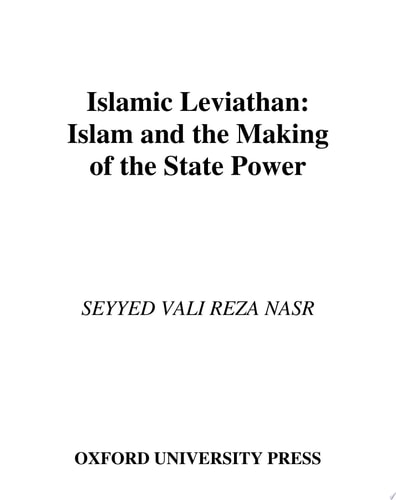
Islamic Leviathan: Islam and the Making of State Power
0
0
As an Amazon Associate and affiliate partner, Menrva Books earns from qualifying purchases. Learn more
Author Description
Islamization is commonly seen as the work of Islamist movements who have forced their ideology on ruling regimes and other hapless social actors. There is little doubt that ruling regimes and disparate social and political actors alike are pushed in the direction of Islamic politics by Islamist forces. However, Islamist activism and its revolutionary and utopian rhetoric only partly explain this trend. Here, Nasr argues that the state itself plays a key role in embedding Islam in the politics of Muslim countries. Focusing on Malaysia and Pakistan, Nasr argues that the turn to Islam is a facet of the state's drive to establish hegemony over society and expand its powers and control.
Menrva's Summary
THE THESIS
Does the state itself, rather than just Islamist movements, drive the process of Islamization to consolidate political power and social control? Seyyed Vali Reza Nasr, a scholar of Middle Eastern and Islamic politics, examines how ruling regimes utilize Islamic rhetoric and institutions to expand their authority. By analyzing the political trajectories of Malaysia and Pakistan, the author demonstrates that the turn toward Islamic politics is often a calculated strategy by the state to achieve hegemony over society and neutralize political opposition.
THE SCOPE MAP
What You Will Find
- Comparative analysis of state-led Islamization in Malaysia and Pakistan
- Theoretical framework regarding state power and religious institutionalization
- Examination of how ruling regimes co-opt Islamist rhetoric for political legitimacy
- Discussion on the interaction between state apparatuses and social actors in Muslim-majority nations
THE AUTHORITY PERSPECTIVE
Scholars and political analysts frequently cite this work as a critical contribution to understanding the intersection of state-building and religious politics. Experts highlight the book's ability to shift the focus from grassroots activism to the institutional mechanisms of the state, providing a nuanced perspective on modern governance in the Muslim world.
Page Count:
248
Publication Date:
2001-09-13
Publisher:
Oxford University Press
ISBN-10:
0195144260
ISBN-13:
9780195144260
Religion
History
Malaysia
Sociology
Islam And Politics
Pakistan
Community Tags
Similar Books