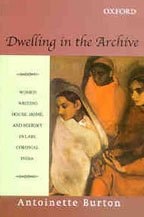
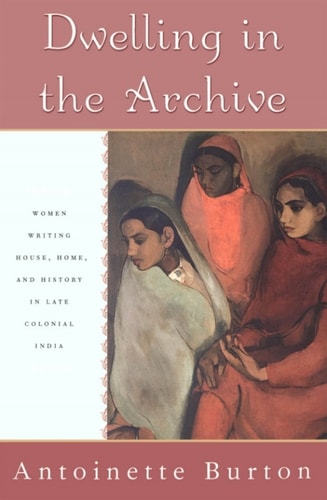
Dwelling in the Archive: Women Writing House, Home, and History in Late Colonial India
0
0
As an Amazon Associate and affiliate partner, Menrva Books earns from qualifying purchases. Learn more
Author Description
Product Description Dwelling in the Archives uses the writing of three 20th century Indian women to interrogate the status of the traditional archive, reading their memoirs, fictions, and histories as counter-narratives of colonial modernity. Janaki Majumdar was the daughter of the first president of the IndianNational Congress. Her unpublished "Family History" (1935) stages the story of her parents' transnational marriage as a series of homes the family inhabited in Britain and India -- thereby providing a heretofore unavailable narrative of the domestic face of 19th century Indian nationalism. CorneliaSorabji was one of the first Indian women to qualify for the bar. Her memoirs (1934 and 1936) demonstrate her determination to rescue the zenana (women's quarters) and purdahashin (secluded women) from the recesses of the orthodox home in order to counter the emancipationist claims of Gandhiannationalism. Last but not least, Attia Hosain's 1961 novel, "Sunlight on Broken Column" represents the violence and trauma of partition through the biography of a young heroine called Laila and her family home. Taken together, their writings raise questions about what counts as an archive, offeringus new insights into the relationship of women to memory and history, gender to fact and fiction, and feminism to nationalism and postcolonialism. About the Author Antoinette Burton is Professor of History at the University of Illinois
Menrva's Summary
THE THESIS
This work investigates how the writings of three 20th-century Indian women challenge traditional archival definitions by serving as counter-narratives to colonial modernity. Antoinette Burton, a Professor of History at the University of Illinois, utilizes a methodology that treats memoirs, fiction, and personal histories as primary historical evidence. By analyzing the domestic spaces described by Janaki Majumdar, Cornelia Sorabji, and Attia Hosain, the author constructs a framework that links private memory to the broader political shifts of Indian nationalism and postcolonial identity.
THE SCOPE MAP
What You Will Find
- Analysis of 20th-century Indian women's memoirs, novels, and unpublished family histories.
- Examination of the intersection between domestic space, gender, and national identity.
- Critical interrogation of the status of the traditional archive in colonial and postcolonial studies.
- Case studies focusing on the works of Janaki Majumdar, Cornelia Sorabji, and Attia Hosain.
THE AUTHORITY PERSPECTIVE
Scholars in the field of postcolonial history frequently cite this text for its innovative approach to archival research and gendered historiography. Readers often note the academic density of the prose, which provides a rigorous examination of how personal narratives reshape our understanding of historical record-keeping.
Page Count:
216
Publication Date:
2003-01-30
Publisher:
Oxford University Press
ISBN-10:
0195144244
ISBN-13:
9780195144246
Biography
History
India
Literary Criticism
Women Studies
Women india
Family india
Women and literature
Community Tags
Other Editions(2)
Similar Books