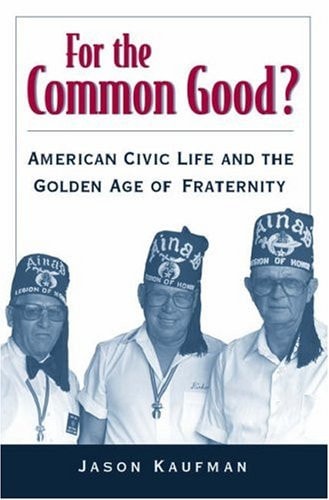
For the Common Good?: American Civic Life and the Golden Age of Fraternity
0
0
As an Amazon Associate and affiliate partner, Menrva Books earns from qualifying purchases. Learn more
Author Description
The Golden Age of Fraternity was a unique time in American history. In the forty years between the Civil War and the onset of World War I, more than half of all Americans participated in clubs, fraternities, militias, and mutual benefit societies. Today this period is held up as a model for how we might revitalize contemporary civil society. But was America's associational culture really as communal as has been assumed? What if these much-admired voluntary organizations served parochial concerns rather than the common good?Jason Kaufman sets out to dispel many of the myths about the supposed civic-mindedness of "joining" while bringing to light the hidden lessons of associationalism's history. Relying on deep archival research in city directories, club histories, and membership lists, Kaufman shows that organizational activity in the late nineteenth and early twentieth centuries revolved largely around economic self-interest rather than civic engagement. And far from spurring concern for the collective good, fraternal societies, able to pick and choose members at will, fostered exclusion and further exacerbated the competitive interests of a society divided by race, class, ethnicity, and religion. Tracing both the rise and the decline of American associational life - a decline that began immediately after World War I, much earlier than previously thought - Kaufman argues persuasively that the end of fraternalism was a good thing.Illuminating both broad historical shifts - immigration, urbanization, and the disruptions of war, among them - and smaller, overlooked contours, such as changes in the burial and life insurance industries, Kaufman has written a bracing revisionist history. Eloquently rebutting those hailing America's associational past and calling for a return to old-style voluntarism, For the Common Good? will change the terms of debate about the history - and the future - of American civil society.
Menrva's Summary
THE THESIS
Did the proliferation of voluntary organizations during the American Golden Age of Fraternity actually foster civic engagement, or did it primarily serve exclusionary, self-interested agendas? Jason Kaufman, a scholar of American social history, challenges the prevailing nostalgia for late nineteenth-century associational life. By analyzing archival data from city directories and membership records, he argues that these organizations were often vehicles for economic advancement and social stratification rather than the common good, suggesting that their decline was a positive development for a more inclusive society.
THE SCOPE MAP
What You Will Find
- Analysis of American associational life between the Civil War and World War I.
- Examination of the economic motivations behind fraternal, militia, and mutual benefit societies.
- Evidence derived from city directories, club histories, and membership lists.
- A revisionist perspective on the impact of immigration, urbanization, and industry changes on social cohesion.
THE AUTHORITY PERSPECTIVE
Historians and sociologists recognize this work as a significant revisionist contribution to the study of American civil society. Readers frequently note the academic density of the prose and the author's rigorous use of archival evidence to dismantle long-standing historical myths.
Page Count:
304
Publication Date:
2002-09-05
Publisher:
Oxford University Press
ISBN-10:
0195148576
ISBN-13:
9780195148572
History
Associations institutions
Social Science
Voluntarism
American History
Sociology
Community Tags
Other Editions(2)
Similar Books



Reader Comments
Share Your Thoughts
No comments yet. Be the first to share your thoughts!