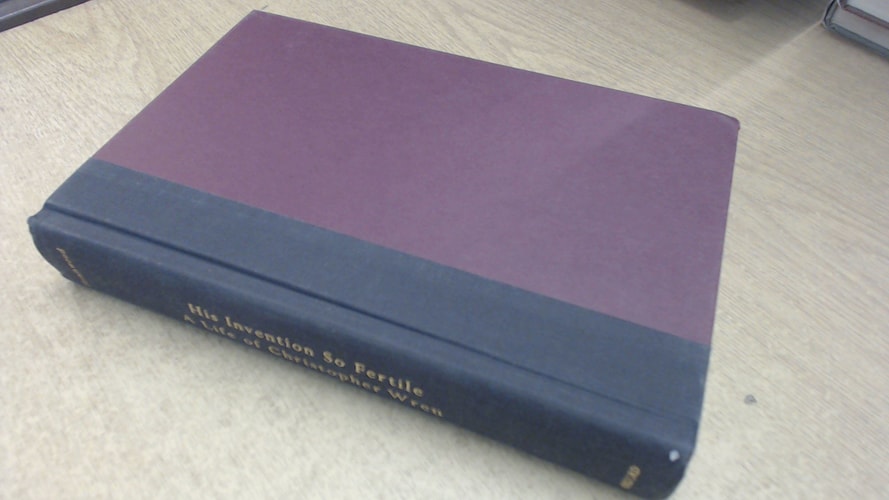
His Invention So Fertile: A Life of Christopher Wren
0
0
As an Amazon Associate and affiliate partner, Menrva Books earns from qualifying purchases. Learn more
Author Description
In His Invention So Fertile, Adrian Tinniswood offers the first biography of Christopher Wren in a generation. It is a book that reveals the full depth of Wren's multifaceted genius, not only as one of the greatest architects who ever lived--the designer of St. Paul's Cathedral--but as an influential seventeenth-century scientist.Tinniswood writes with insight and flair as he follows Wren from Wadham College, Oxford, through the turmoil of the English Civil War, to his role in helping to found the Royal Society--the intellectual and scientific heart of seventeenth-century England. The reader discovers that the great architect was initially an astronomer who was also deeply interested in medicine, physics, and mathematics. Family connections pulled him into architecture, with a commission to restore the chapel at Pembroke College, Cambridge. Tinniswood deftly follows Wren's rise as architect, capturing the atmosphere of Restoration London, as old Royalists scrambled for sinecures from Charles II and Wren learned the art of political infighting at court, finally becoming Surveyor of the Royal Works-the King's engineer. Most important, the author recounts the intriguing story of the building of St. Paul's. The Great Fire of 1666--vividly recreated in Tinniswood's narrative--left London a smoldering husk. Wren played a central role in reshaping the city, culminating with St. Paul's, his masterpiece--though he had to steer between King and cathedral authorities to get his radical, domed design built. As the Enlightenment dawned in England, Wren's magnificent dome rose above London, soon to become an icon of London and world architecture.One of the most influential architects in history, Christopher Wren comes vividly to life in this fittingly grand biography.
Menrva's Summary
THE THESIS
This biography investigates the multifaceted life and intellectual contributions of Christopher Wren, challenging the narrow perception of him as solely an architect. Adrian Tinniswood utilizes extensive historical records and correspondence to frame Wren not merely as the designer of St. Paul's Cathedral, but as a pivotal figure in the scientific revolution of seventeenth-century England. The narrative tracks his transition from an academic astronomer and polymath to the Surveyor of the Royal Works, illustrating how his scientific rigor informed his structural innovations. By situating Wren within the volatile political landscape of Restoration London, Tinniswood argues that his success relied as much on political navigation as it did on mathematical genius.
THE SCOPE MAP
What You Will Find
- Detailed examination of seventeenth-century scientific circles, including the formation of the Royal Society.
- Analysis of the architectural reconstruction of London following the Great Fire of 1666.
- Primary source documentation regarding the political and ecclesiastical conflicts surrounding the construction of St. Paul's Cathedral.
- Contextual history of the English Civil War and the Restoration court of Charles II.
THE AUTHORITY PERSPECTIVE
Experts and historians recognize this work as a comprehensive and authoritative account that successfully bridges the gap between Wren's scientific and architectural legacies. Readers frequently note the meticulous research and the clarity with which Tinniswood navigates the complex political environment of the era.
Page Count:
504
Publication Date:
2001-11-29
Publisher:
Oxford University Press
ISBN-10:
0195149890
ISBN-13:
9780195149890
History
Biography
Science
Architecture
Seventeenth Century
Architects biography
British History
Community Tags
Other Editions(3)

Similar Books


Reader Comments
Share Your Thoughts
No comments yet. Be the first to share your thoughts!