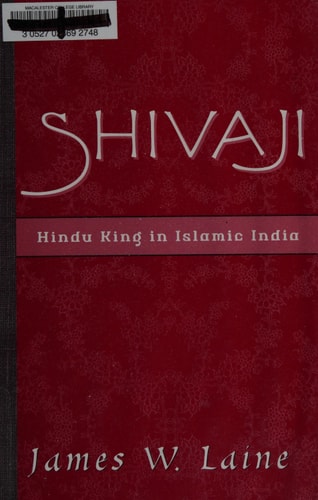
Shivaji: Hindu King in Islamic India
0
0
As an Amazon Associate and affiliate partner, Menrva Books earns from qualifying purchases. Learn more
Author Description
Shivaji is a well-known hero in western India. He defied Mughal power in the seventeenth century, established an independent kingdom, and had himself crowned in an orthodox Hindu ceremony. The legends of his life have become an epic story that everyone in western India knows, and an important part of the Hindu nationalists' ideology. To read Shivaji's legend today is to find expression of deeply held convictions about what Hinduism means and how it is opposed to Islam.James Laine traces the origin and development if the Shivaji legend from the earliest sources to the contemporary accounts of the tale. His primary concern is to discover the meaning of Shivaji's life for those who have composed-and those who have read-the legendary accounts of his military victories, his daring escapes, his relationships with saints. In the process, he paints a new and more complex picture of Hindu-Muslim relations from the seventeenth century to the present. He argues that this relationship involved a variety of compromises and strategies, from conflict to accommodation to nuanced collaboration. Neither Muslims nor Hindus formed clearly defined communities, says Laine, and they did not relate to each other as opposed monolithic groups. Different sub-groups, representing a range of religious persuasions, found it in their advantage to accentuate or diminish the importance of Hindu and Muslim identity and the ideologies that supported the construction of such identities. By studying the evolution of the Shivaji legend, Laine demonstrates, we can trace the development of such constructions in both pre-British and post-colonial periods.
Menrva's Summary
THE THESIS
This work investigates how the historical figure of Shivaji has been mythologized and utilized to construct shifting religious and political identities in India from the seventeenth century to the present. James W. Laine, a scholar of religious studies, examines the evolution of the Shivaji legend by analyzing primary sources, hagiographies, and contemporary nationalist narratives. He argues that the historical reality of Hindu-Muslim relations was characterized by complex patterns of accommodation and collaboration rather than the monolithic conflict often depicted in modern ideological discourse.
THE SCOPE MAP
What You Will Find
- An analysis of the historical seventeenth-century context of the Maratha kingdom and Mughal power.
- A critical examination of hagiographical literature and oral traditions surrounding Shivaji.
- A study of how religious identity is constructed and manipulated for political purposes in post-colonial India.
- A nuanced framework for understanding the fluidity of Hindu-Muslim interactions throughout Indian history.
THE AUTHORITY PERSPECTIVE
Scholars and historians frequently cite this text for its rigorous deconstruction of nationalist myths and its balanced approach to complex religious history. Readers often note the academic density of the prose, which serves as a foundational resource for those studying the intersection of regional identity and religious politics in South Asia.
Page Count:
144
Publication Date:
2003-02-13
Publisher:
Oxford University Press
ISBN-10:
0195141261
ISBN-13:
9780195141269
History
Biography
Religion
Islam
Muslims india
Hinduism
India
India - History
Community Tags
Similar Books