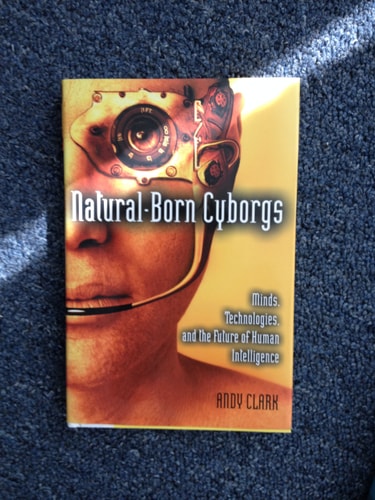
Natural-Born Cyborgs: Minds, Technologies, and the Future of Human Intelligence
0
0
As an Amazon Associate and affiliate partner, Menrva Books earns from qualifying purchases. Learn more
Author Description
From Robocop to the Terminator to Eve 8, no image better captures our deepest fears about technology than the cyborg, the person who is both flesh and metal, brain and electronics. But philosopher and cognitive scientist Andy Clark sees it differently. Cyborgs, he writes, are not something to be feared--we already are cyborgs.In Natural-Born Cyborgs, Clark argues that what makes humans so different from other species is our capacity to fully incorporate tools and supporting cultural practices into our existence. Technology as simple as writing on a sketchpad, as familiar as Google or a cellular phone, and as potentially revolutionary as mind-extending neural implants--all exploit our brains' astonishingly plastic nature. Our minds are primed to seek out and incorporate non-biological resources, so that we actually think and feel through our best technologies. Drawing on his expertise in cognitive science, Clark demonstrates that our sense of self and of physical presence can be expanded to a remarkable extent, placing the long-existing telephone and the emerging technology of telepresence on the same continuum. He explores ways in which we have adapted our lives to make use of technology (the measurement of time, for example, has wrought enormous changes in human existence), as well as ways in which increasingly fluid technologies can adapt to individual users during normal use. Bio-technological unions, Clark argues, are evolving with a speed never seen before in history. As we enter an age of wearable computers, sensory augmentation, wireless devices, intelligent environments, thought-controlled prosthetics, and rapid-fire information search and retrieval, the line between the user and her tools grows thinner day by day. "This double whammy of plastic brains and increasingly responsive and well-fitted tools creates an unprecedented opportunity for ever-closer kinds of human-machine merger," he writes, arguing that such a merger is entirely natural.
Menrva's Summary
THE THESIS
Does the human capacity to integrate external tools and technologies into our cognitive processes suggest that we are already cyborgs by nature? Andy Clark, a philosopher and cognitive scientist, utilizes his expertise in the mechanics of the mind to argue that human intelligence is not confined to the biological brain. He posits that our evolutionary history is defined by a unique plasticity that allows us to incorporate non-biological resources—from simple writing instruments to complex neural implants—directly into our thinking and feeling processes.
THE SCOPE MAP
What You Will Find
- Analysis of neuroplasticity and the brain's inherent readiness to incorporate external tools.
- Historical and contemporary examples of technology integration, including time-keeping and digital communication.
- Exploration of the continuum between simple tools like sketchpads and advanced telepresence or neural implants.
- Examination of the evolving relationship between human identity and wearable or responsive computing devices.
THE AUTHORITY PERSPECTIVE
Experts in cognitive science and philosophy recognize this work as a foundational text for understanding the extended mind thesis. Readers frequently note the accessible yet rigorous academic approach Clark takes in bridging the gap between biological evolution and technological advancement.
Page Count:
240
Publication Date:
2003-04-01
Publisher:
Oxford University Press
ISBN-10:
0195148665
ISBN-13:
9780195148664
Politics
Philosophy
Psychology
Science
Social Aspects
Kindle Store
Kindle eBooks
Strategy Guides
Cognitive
Technology
Cybernetics
Robotics
Future Studies
Machine Learning
Categories
Engineering
Consciousness & Thought
Neurosciences
Manufacturing Systems
Human Interaction
Community Tags
Similar Books