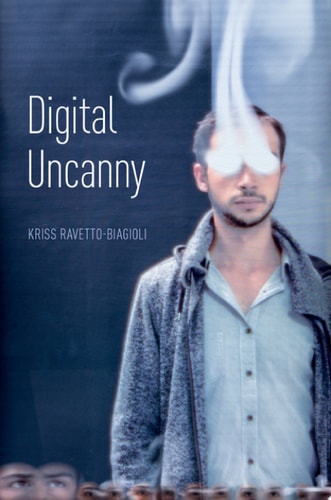
Digital Uncanny
0
0
As an Amazon Associate and affiliate partner, Menrva Books earns from qualifying purchases. Learn more
Author Description
We are now confronted with a new type of uncanny experience, an uncanny evoked by parallel processing, aggregate data, and cloud-computing. The digital uncanny does not erase the uncanny feeling we experience as déjà vu or when confronted with robots that are too lifelike. Today's uncanny refers to how non-human devices (surveillance technologies, algorithms, feedback, and data flows) anticipate human gestures, emotions, actions, and interactions, thus intimating that we are but machines and that our behavior is predicable precisely because we are machinic. It adds another dimension to those feelings in which we question whether our responses are subjective or automated - automated as in reducing one's subjectivity to patterns of data and using those patterns to present objects or ideas that would then elicit one's genuinely subjective-yet effectively preset-response. In fact, this anticipation of our responses is a feedback loop that we humans have produced by designing software that can study our traces, inputs, and moves. In this sense one could say that the digital uncanny is a trick we play on ourselves, a trick that we would not be able to play had we not developed sophisticated digital technologies. Digital Uncanny explores how digital technologies, particularly software systems working through massive amounts of data, are transforming the meaning of the uncanny that Freud tied to a return of repressed memories, desires, and experiences to their anticipation. Through a close reading of interactive and experimental art works of Rafael Lozano-Hemmer, Bill Viola, Simon Biggs, Sue Hawksley, and Garth Paine, this book is designed to explore how the digital uncanny unsettles and estranges concepts of "self," "affect," "feedback" and "aesthetic experience," forcing us to reflect on our relationship with computational media and by extension our relationship to each other and our experience of the world.
Menrva's Summary
THE THESIS
This book investigates how contemporary digital technologies, specifically algorithms and data-driven feedback loops, have transformed the traditional Freudian concept of the uncanny into a modern experience of machine-mediated anticipation. Kriss Ravetto-Biagioli, a scholar in media and cultural studies, utilizes a theoretical framework that bridges psychoanalysis and computational theory. She argues that as software systems increasingly predict human behavior through data patterns, the boundary between subjective human agency and automated response becomes blurred, creating a new form of psychological estrangement.
THE SCOPE MAP
What You Will Find
- Analysis of surveillance technologies, algorithms, and cloud-computing feedback loops
- Theoretical re-evaluation of the Freudian uncanny in the context of digital media
- Close readings of interactive and experimental art installations by Rafael Lozano-Hemmer, Bill Viola, Simon Biggs, Sue Hawksley, and Garth Paine
Scope Limits
- The text does not provide a technical manual for software engineering or data science
- It does not offer a comprehensive history of all digital art movements, focusing instead on specific works that illustrate the digital uncanny
THE AUTHORITY PERSPECTIVE
Scholars in media studies and digital aesthetics frequently cite this work for its rigorous application of psychoanalytic theory to contemporary computational systems. Readers often note the academic density of the prose, which requires a foundational understanding of both media theory and philosophy to fully grasp the author's arguments.
Page Count:
230
Publication Date:
2018-01-01
Publisher:
Oxford University Press
ISBN-10:
0190854022
ISBN-13:
9780190854027
Philosophy
Media Studies
Technology
Automation
Professional Career & Trade
Art Theory
Sociology
Cyberspace
Graphic ArtsCommunicationsDesign
Film & Video
Community Tags
Other Editions(3)


Similar Books









Reader Comments
Share Your Thoughts
No comments yet. Be the first to share your thoughts!