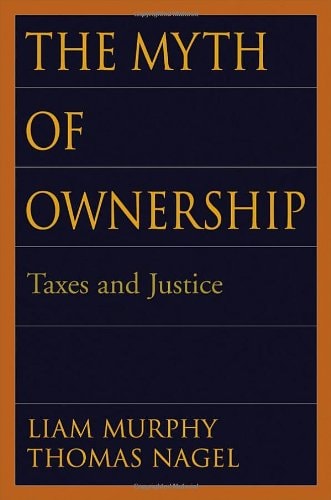
The Myth of Ownership: Taxes and Justice
0
0
As an Amazon Associate and affiliate partner, Menrva Books earns from qualifying purchases. Learn more
Author Description
In a capitalist economy, taxes are the most important instrument by which the political system puts into practice a conception of economic and distributive justice. Taxes arouse strong passions, fueled not only by conflicts of economic self-interest, but by conflicting ideas of fairness. Taking as a guiding principle the conventional nature of private property, Murphy and Nagel show how taxes can only be evaluated as part of the overall system of property rights that they help to create. Justice or injustice in taxation, they argue, can only mean justice or injustice in the system of property rights and entitlements that result from a particular regime. Taking up ethical issues about individual liberty, interpersonal obligation, and both collective and personal responsibility, Murphy and Nagel force us to reconsider how our tax policy shapes our system of property rights.
Menrva's Summary
THE THESIS
How can a society determine the fairness of a tax system when property rights themselves are a product of the legal and political framework? Liam B. Murphy and Thomas Nagel, both distinguished scholars in law and philosophy, challenge the common assumption that individuals have a pre-political right to their pre-tax income. They argue that because property rights are defined by the tax system itself, one cannot evaluate tax policy in isolation from the broader distributive outcomes it creates for society.
THE SCOPE MAP
What You Will Find
- An analysis of the conventional nature of private property rights.
- A critique of the 'libertarian' view that taxes constitute an infringement on personal earnings.
- Ethical frameworks for evaluating distributive justice and interpersonal obligations.
- A discussion on the relationship between collective responsibility and individual entitlements.
THE AUTHORITY PERSPECTIVE
Experts and academics frequently cite this work as a foundational text for understanding the intersection of political philosophy and fiscal policy. Readers often note the rigorous, analytical density of the prose, which demands careful attention to the authors' logical arguments regarding property and justice.
Page Count:
240
Publication Date:
2002-04-11
Publisher:
Oxford University Press
ISBN-10:
0195150163
ISBN-13:
9780195150162
Economics
Politics
Philosophy
Kindle Store
Tax Law
Categories
Taxation
Jurisprudence
Property
Systems Theory
Kindle eBooks
Law
Community Tags
Similar Books