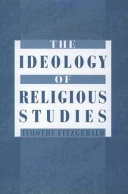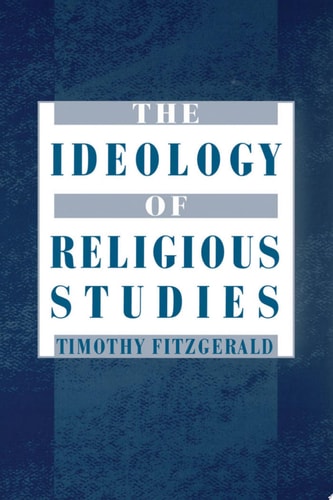
The Ideology of Religious Studies
0
0
As an Amazon Associate and affiliate partner, Menrva Books earns from qualifying purchases. Learn more
Author Description
In recent years there has been an intensifying debate within the religious studies community about the validity of religion as an analytical category. In this book Fitzgerald sides with those who argue that the concept of religion itself should be abandoned. On the basis of his own research in India and Japan, and through a detailed analysis of the use of religion in a wide range of scholarly texts, the author maintains that the comparative study of religion is really a form of liberal ecumenical theology. By pretending to be a science, religion significantly distorts socio-cultural analysis. He suggest, however, that religious studies can be re-represented in a way which opens up new and productive theoretical connections with anthropology and cultural and literary studies.
Menrva's Summary
THE THESIS
This book investigates the validity of 'religion' as an analytical category, arguing that the concept itself is fundamentally flawed and should be abandoned by scholars. Timothy Fitzgerald, a scholar with extensive research experience in India and Japan, critiques the field of religious studies for functioning as a form of liberal ecumenical theology rather than a rigorous social science. He posits that the current usage of the term distorts socio-cultural analysis and proposes a shift toward theoretical integration with anthropology and cultural studies to revitalize the discipline.
THE SCOPE MAP
What You Will Find
- A critical analysis of the term 'religion' as used in contemporary scholarly texts.
- Empirical evidence drawn from the author's field research in India and Japan.
- A methodological critique of religious studies as a disguised theological project.
- Theoretical proposals for re-aligning the field with anthropology and cultural studies.
THE AUTHORITY PERSPECTIVE
Experts in the field recognize this work as a provocative and foundational text for those questioning the secular neutrality of religious studies. Readers frequently note the dense, argumentative nature of the prose, which challenges long-standing academic conventions.
Page Count:
272
Publication Date:
2003-10-16
Publisher:
Oxford University Press
ISBN-10:
0195167694
ISBN-13:
9780195167696
Philosophy
Religion
Anthropology
Religion
Sociology