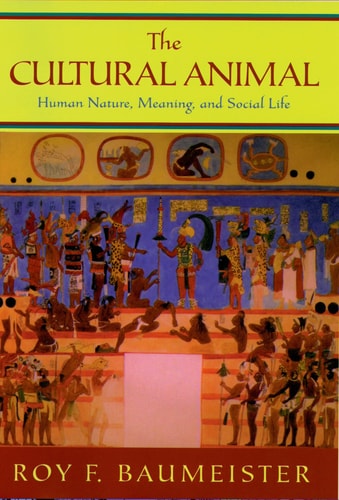
The Cultural Animal: Human Nature, Meaning, and Social Life
0
0
As an Amazon Associate and affiliate partner, Menrva Books earns from qualifying purchases. Learn more
Author Description
What makes us human? Why do people think, feel and act as they do? What is the essence of human nature? What is the basic relationship between the individual and society? These questions have fascinated both great thinkers and ordinary humans for centuries. Now, at last, there is a solid basis for answering them, in the form of accumulated efforts and studies by thousands of psychology researchers. We no longer have to rely on navel-gazing and speculation to understand why people are the way they are - we can instead turn to solid, objective findings. This book, by an eminent social psychologist at the peak of his career, not only summarizes what we know about people - it also offers a coherent, easy-to-understand, though radical, explanation. Turning conventional wisdom on its head, the author argues that culture shaped human evolution. Contrary to theories that depict the individual's relation to society as one of victimization, endless malleability, or just a square peg in a round hole, he proposes that the individual human being is designed by nature to be part of society. Moreover, he argues that we need to briefly set aside the endless study of cultural differences to look at what most cultures have in common - because that holds the key to human nature. Culture is in our genes, although cultural differences may not be. This core theme is further developed by a powerful tour through the main dimension of human psychology. What do people want? How do people think? How do emotions operate? How do people behave? And how do they interact with each other? The answers are often surprising, and along the way the author explains how human desire, thought, feeling, and action are connected.
Menrva's Summary
THE THESIS
This book investigates the fundamental question of what constitutes human nature by proposing that humans are biologically designed to function within a cultural framework. Roy F. Baumeister, a prominent social psychologist, synthesizes decades of empirical research to argue that culture is not an external force acting upon individuals, but rather an evolutionary adaptation. He posits that the human psyche is structured to facilitate social interaction, suggesting that the key to understanding human behavior lies in identifying the universal traits shared across all cultures rather than focusing on their differences.
THE SCOPE MAP
What You Will Find
- An evolutionary framework explaining how culture shaped human biological development.
- A synthesis of empirical findings regarding human desire, cognition, and emotional regulation.
- An analysis of the relationship between individual psychological needs and social integration.
- A comparative look at universal human traits that transcend specific cultural variations.
THE AUTHORITY PERSPECTIVE
Experts recognize this work as a comprehensive synthesis of social psychological research that successfully bridges the gap between biological evolution and social behavior. Readers frequently note the clarity of the author's prose, which makes complex psychological theories accessible to both students and general audiences.
Page Count:
464
Publication Date:
2005-02-10
Publisher:
Oxford University Press
ISBN-10:
0195167031
ISBN-13:
9780195167030
Non-Fiction
Psychology
Evolutionary Psychology
Sociology
Human Nature
Community Tags
Similar Books