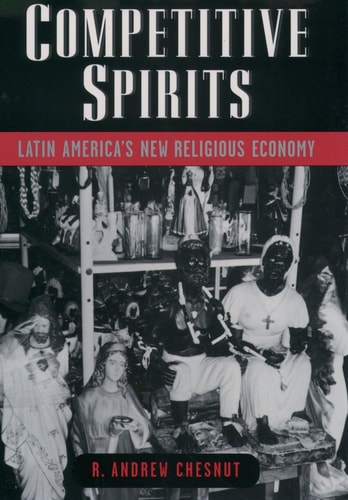
Competitive Spirits: Latin America's New Religious Economy
0
0
As an Amazon Associate and affiliate partner, Menrva Books earns from qualifying purchases. Learn more
Author Description
For over four centuries the Catholic Church enjoyed a religious monopoly in Latin America in which potential rivals were repressed or outlawed. Latin Americans were born Catholic and the only real choice they had was whether to actively practice the faith. Taking advantage of the legal disestablishment of the Catholic Church between the late 1800s and the early 1900s, Pentecostals almost single-handedly built a new pluralist religious economy. By the 1950s, many Latin Americans were free to choose from among the hundreds of available religious "products," a dizzying array of religious options that range from the African-Brazilian religion of Umbanda to the New Age group known as the Vegetable Union.R. Andrew Chesnut shows how the development of religious pluralism over the past half-century has radically transformed the "spiritual economy" of Latin America. In order to thrive in this new religious economy, says Chesnut, Latin American spiritual "firms" must develop an attractive product and know how to market it to popular consumers. Three religious groups, he demonstrates, have proven to be the most skilled competitors in the new unregulated religious economy. Protestant Pentecostalism, the Catholic Charismatic Renewal, and African diaspora religions such as Brazilian Candomble and Haitian Vodou have emerged as the most profitable religious producers. Chesnut explores the general effects of a free market, such as introduction of consumer taste and product specialization, and shows how they have played out in the Latin American context. He notes, for example, that women make up the majority of the religious consumer market, and explores how the three groups have developed to satisfy women's tastes and preferences. Moving beyond the Pentecostal boom and the rise and fall of liberation theology, Chesnut provides a fascinating portrait of the Latin American religious landscape.
Menrva's Summary
THE THESIS
This book investigates how the transition from a Catholic religious monopoly to a competitive, pluralistic market has fundamentally altered the spiritual landscape of Latin America. R. Andrew Chesnut, a scholar of Latin American religion, utilizes economic theory to analyze how various religious organizations function as firms competing for consumers. By examining the shift from state-sanctioned religious hegemony to a free-market model, the author argues that successful religious groups must now innovate, specialize, and market their services to survive in a diverse spiritual economy.
THE SCOPE MAP
What You Will Find
- Analysis of the transition from Catholic monopoly to religious pluralism in Latin America.
- Application of economic frameworks to religious institutions, treating them as competing firms.
- Examination of the specific market strategies employed by Pentecostalism, Catholic Charismatic Renewal, and African diaspora religions.
- Investigation into the role of gender and consumer preference in shaping the success of religious products.
THE AUTHORITY PERSPECTIVE
Experts recognize this work as a significant contribution to the study of religious change in the Global South, particularly for its innovative use of economic metaphors to explain institutional growth. Readers frequently note the clarity of the author's prose and the depth of his analysis regarding the competitive dynamics between diverse faith traditions.
Page Count:
200
Publication Date:
2003-08-07
Publisher:
Oxford University Press
ISBN-10:
019516184X
ISBN-13:
9780195161847
Economics
Religion
History
Economics
Sociology
Community Tags
Other Editions(2)

Similar Books



Reader Comments
Share Your Thoughts
No comments yet. Be the first to share your thoughts!