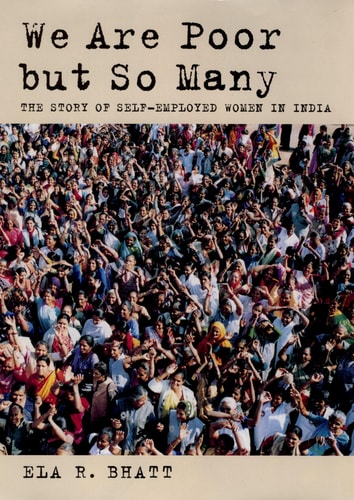
We Are Poor but So Many: The Story of Self-Employed Women in India
0
0
As an Amazon Associate and affiliate partner, Menrva Books earns from qualifying purchases. Learn more
Author Description
Ela Bhatt is widely recognized as one of the world's most remarkable pioneers and entrepreneurial forces in grassroots development. Known as the "gentle revolutionary," she has dedicated her life to improving the lives of India's poorest and most oppressed citizens. In India, where 93 percent of the labor force are self-employed, 94 percent of this sector are women. Yet self-employed women have historically enjoyed few legal protections or worker's rights. In fact, most are illiterate and subject to exploitation and harassment by moneylenders, employers, and officials. Witnessing the terrible conditions faced by women working as weavers, stitchers, cigarette rollers, and waste collectors, Ela Bhatt began helping these women to organize themselves. In 1972, Ela Bhatt founded the Self-Employed Women's Association (SEWA) to bring poor women together and give them ways to fight for their rights and earn better livings. Three years after SEWA was founded, it had 7,000 members. Today it has a total membership of 700,000 women, making it the largest single primary trade union in India. Bhatt lead SEWA to form a cooperative bank in 1974 - with a share capital of $30,000 - that offered microcredit loans to help women save and become financially independent. Today the SEWA Cooperative Bank has $1.5 million in working capital and more than 30,000 depositors with a loan return rate of 94 percent. Through years of organization and strategic action, Ela Bhatt developed SEWA from a small, often ignored group into a powerful trade union and bank with allies around the world. During the last three decades, SEWA's efforts to increase the bargaining power, economic opportunities, health security, legal representation, and organizational abilities of Indian women have brought dramatic improvements to hundreds of thousands of lives and influenced similar initiatives around the globe. We Are Poor but So Many is a first-hand account of the vision, rise, and success of SEWA, in India as we
Menrva's Summary
THE THESIS
How can the collective organization of self-employed women in the informal labor sector transform systemic poverty into economic agency? Ela R. Bhatt, a renowned grassroots activist and founder of the Self-Employed Women's Association (SEWA), presents a first-hand account of the strategies used to empower India's most marginalized female workers. The text details the transition of these women from isolated, exploited laborers into a unified, politically and economically active force through the creation of trade unions and cooperative banking systems.
THE SCOPE MAP
What You Will Find
- Historical development of the Self-Employed Women's Association (SEWA) from 1972 to the present.
- Methodologies for establishing microcredit institutions and cooperative banks for the unbanked.
- Case studies of women working in informal sectors such as weaving, waste collection, and cigarette rolling.
- Analysis of bargaining power, legal representation, and health security as tools for poverty alleviation.
THE AUTHORITY PERSPECTIVE
Experts and development scholars frequently cite this work as a foundational text for understanding the intersection of microfinance and labor rights in the Global South. Readers often note the clarity of Bhatt's prose, which balances personal narrative with the practical mechanics of grassroots organizational development.
Page Count:
248
Publication Date:
2005-12-15
Publisher:
Oxford University Press
ISBN-10:
0195169840
ISBN-13:
9780195169843
Economics
Biography
Labor history
Social Science
Poor_india
Self-employed
India
Women india
Community Tags
Other Editions(2)
Similar Books



Reader Comments
Share Your Thoughts
No comments yet. Be the first to share your thoughts!