Clonal Variations of Syzygium Cuminii Vindicated by Various Indices
0
0
As an Amazon Associate and affiliate partner, Menrva Books earns from qualifying purchases. Learn more
Author Description
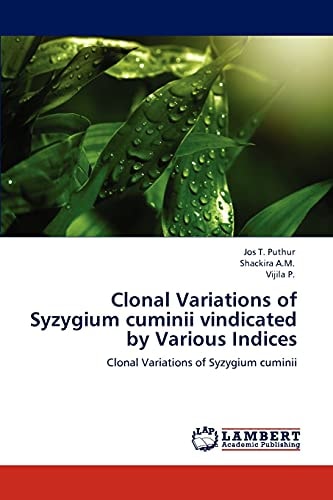
Clonal progenital variations of Syzgium cuminii L. was studied using morphological, physiological and biochemical indices. Although variations such as leaf size and shape exist in the clonal progenies as compared to the mother plant, it was found to be insignificant as per the values of test of significance. As per the coefficient of correlation, the variation of clonal progenies from the mother plant was established, considering the above features. On considering morphological and physiological features, progeny S1 which appeared to have almost similar morphology to the mother plant was having highest value of correlation followed by S2, which was distinctly different for the mother plant and progenies, followed by S4 and then S3. But considering the biochemical features alone, the highest value of correlation was recorded by S4 and the lowest by S3. Considering all the three features together, the highest value of correlation was observed in S4, followed by S1, S2, and finally S3. So, this is a clear cut proof that on establishing the variation of the clonal progenies and establishing it as somaclonal variant, analysis of all the three parameters becomes essential.
Menrva's Summary
THE THESIS
This study investigates the genetic variations within clonal progenies of Syzygium cuminii (Jamun tree) using a multi-faceted approach. The research examines morphological, physiological, and biochemical indices to determine the extent to which these clonal offspring differ from the parent plant, aiming to validate their status as somaclonal variants and establish the necessity of analyzing all three parameter types for accurate assessment.
THE SCOPE MAP
- Analysis of morphological variations including leaf size and shape.
- Assessment of physiological differences between clonal progenies and the mother plant.
- Evaluation of biochemical variations in clonal progenies.
- Statistical significance testing for observed variations.
- Calculation of the coefficient of correlation to quantify variation.
- Comparative analysis of four distinct clonal progenies (S1, S2, S3, S4).
- Determination of the most reliable parameters for identifying somaclonal variation.
THE AUTHORITY PERSPECTIVE
This technical paper presents a detailed scientific analysis of clonal variations in Syzygium cuminii, focusing on the statistical validation of morphological, physiological, and biochemical differences. The study's rigor in correlating these diverse parameters to confirm somaclonal variation is evident. The findings suggest that a comprehensive analysis across all three domains is essential for accurately characterizing such genetic divergences. The work is positioned as a contribution to botanical and genetic research, likely appealing to specialists in plant science and agricultural genetics.
Page Count:
60
Publication Date:
2012-03-01
Publisher:
Lap Lambert Academic Publishing GmbH KG
ISBN-10:
384842391X
ISBN-13:
9783848423910
Science
Non-Fiction
Agriculture
Biochemistry
Botany
Genetics
Community Tags
Similar Books