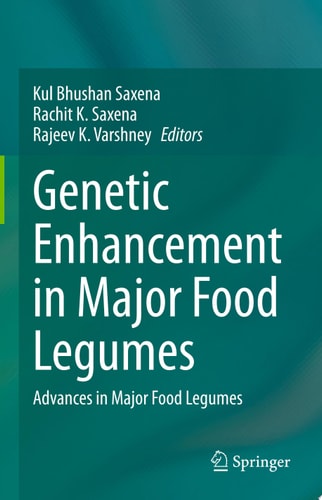
Genetic Enhancement in Major Food Legumes
0
0
As an Amazon Associate and affiliate partner, Menrva Books earns from qualifying purchases. Learn more
Author Description
The protein molecule is the basic building block of every living entity. Its deficiency leads to restricted growth and development of individuals. Globally, such malnutrition is on the rise due to various reasons such as rapid population growth, stagnation of productivity, and ever-rising costs. Millions of people, especially in developing and under-developed countries, suffer from protein malnutrition and the only possible solution is to encourage farmers to grow high-protein food legume crops in their fields for domestic consumption. This, however, could be possible if farmers are provided with new cultivars with high yield, and resistance to major insects, diseases, and key abiotic stresses. The major food legume crops are chickpea, cowpea, common bean, groundnut, lentil, pigeonpea, and soybean. Predominantly, the legume crops are grown under a subsistence level and, therefore, in comparison to cereals and horticultural crops their productivity is low and highly variable. The crop breeders around the globe are engaged in breeding suitable cultivars for harsh and changing environments but success has been limited and not up to needs. With the recent development of new technologies in plant sciences, efforts are being made to help under-privileged farmers through breeding new cultivars which will produce more protein per unit of land area. In this book, the contributors analyze the constraints, review new technologies, and propose a future course of crop breeding programs in seven cold and warm season legume crops.
Menrva's Summary
THE THESIS
This book investigates the critical role of genetic enhancement in improving major food legume crops to combat global protein malnutrition. The authors address the challenges of low productivity, insect and disease resistance, and abiotic stress tolerance in crops like chickpea, cowpea, common bean, groundnut, lentil, pigeonpea, and soybean. It reviews new technologies and proposes future directions for crop breeding programs, aiming to increase protein yield per unit of land area for underprivileged farmers.
THE SCOPE MAP
- Analysis of constraints in major food legume crop cultivation.
- Review of new technologies in plant sciences for crop improvement.
- Focus on breeding new cultivars for high yield and resistance to pests and stresses.
- Examination of genetic enhancement strategies for protein content.
- Discussion of seven cold and warm season legume crops.
- Future course of crop breeding programs for enhanced food security.
THE AUTHORITY PERSPECTIVE
The book addresses a critical global issue of protein malnutrition, exacerbated by population growth and productivity stagnation. It offers a scientific perspective on improving food legume crops through genetic enhancement, focusing on practical solutions for farmers, particularly in developing regions. The contributors analyze existing challenges and explore innovative technologies to develop more resilient and higher-yielding cultivars. This work is positioned to inform crop breeders and researchers on future directions for enhancing food security.
Page Count:
354
Publication Date:
2021-09-28
Publisher:
Springer Nature
ISBN-10:
3030645002
ISBN-13:
9783030645007
Non-Fiction
Science
Genetics
Agriculture
Biotechnology
Plant Science
Food security
Community Tags
Similar Books














