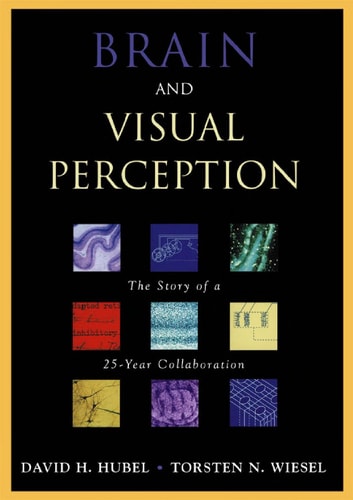
Brain and Visual Perception: The Story of a 25-Year Collaboration
0
0
As an Amazon Associate and affiliate partner, Menrva Books earns from qualifying purchases. Learn more
Author Description
Scientists' understanding of two central problems in neuroscience, psychology, and philosophy has been greatly influenced by the work of David Hubel and Torsten Wiesel: (1) What is it to see? This relates to the machinery that underlies visual perception. (2) How do we acquire the brain's mechanisms for vision? This is the nature-nurture question as to whether the nerve connections responsible for vision are innate or whether they develop through experience in the early life of an animal or human. This is a book about the collaboration between Hubel and Wiesel, which began in 1958, lasted until about 1982, and led to a Nobel Prize in 1981. It opens with short autobiographies of both men, describes the state of the field when they started, and tells about the beginnings of their collaboration. It emphasizes the importance of various mentors in their lives, especially Stephen W. Kuffler, who opened up the field by studying the cat retina in 1950, and founded the department of neurobiology at Harvard Medical School, where most of their work was done. The main part of the book consists of Hubel and Wiesel's most important publications. Each reprinted paper is preceded by a foreword that tells how they went about the research, what the difficulties and the pleasures were, and whether they felt a paper was important and why. Each is also followed by an afterword describing how the paper was received and what developments have occurred since its publication. The reader learns things that are often absent from typical scientific publications, including whether the work was difficult, fun, personally rewarding, exhilarating, or just plain tedious. The book ends with a summing-up of the authors' view of the present state of the field. This is much more than a collection of reprinted papers. Above all it tells the story of an unusual scientific collaboration that was hugely enjoyable and served to transform an entire branch of neurobiology. It will appeal to neuroscientists, v
Menrva's Summary
THE THESIS
How do the mechanisms of visual perception develop, and what is the nature of the collaborative process that leads to foundational scientific discovery? This work chronicles the twenty-five-year partnership between Nobel laureates David H. Hubel and Torsten N. Wiesel, detailing their investigation into the neural architecture of vision. By combining personal autobiographical accounts with their seminal research papers, the authors provide a framework for understanding both the biological basis of sight and the human dynamics of high-level scientific inquiry.
THE SCOPE MAP
What You Will Find
- Historical analysis of neurobiology research from 1958 to 1982.
- Detailed examination of the nature-nurture debate regarding visual development.
- Primary source reprints of key scientific papers with contextual forewords and afterwords.
- Insights into the mentorship and institutional environment at Harvard Medical School.
THE AUTHORITY PERSPECTIVE
Experts recognize this volume as a foundational text that bridges the gap between technical neurobiological research and the history of science. Readers frequently note that the inclusion of personal reflections provides a rare, humanizing perspective on the rigorous process of experimental discovery.
Page Count:
744
Publication Date:
2004-10-14
Publisher:
Oxford University Press
ISBN-10:
0195176189
ISBN-13:
9780195176186
Science
Psychology
Biography
Biology research
Neuroscience
Medicine history
Community Tags
Similar Books


Reader Comments
Share Your Thoughts
No comments yet. Be the first to share your thoughts!