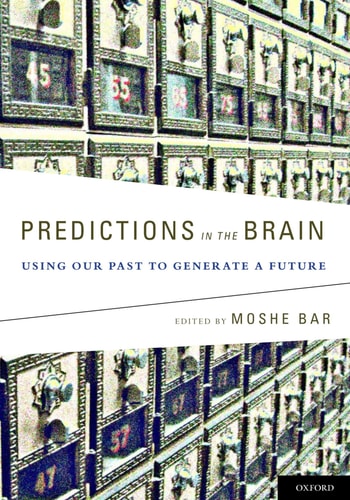
Predictions in the Brain: Using Our Past to Generate a Future
0
0
As an Amazon Associate and affiliate partner, Menrva Books earns from qualifying purchases. Learn more
Author Description
When one is immersed in the fascinating world of neuroscience findings, the brain might start to seem like a collection of "modules," each specializes in a specific mental feat. But just like in other domains of Nature, it is possible that much of the brain and mind's operation can be explained with a small set of universal principles. Given exciting recent developments in theory, empirical findings and computational studies, it seems that the generation of predictions might be one strong candidate for such a universal principle. This is the focus of Predictions in the brain. From the predictions required when a rat navigates a maze to food-caching in scrub-jays; from predictions essential in decision-making to social interactions; from predictions in the retina to the prefrontal cortex; and from predictions in early development to foresight in non-humans.The perspectives represented in this collection span a spectrum from the cellular underpinnings to the computational principles underlying future-related mental processes, and from systems neuroscience to cognition and emotion. In spite of this diversity, they share some core elements. Memory, for instance, is critical in any framework that explains predictions. In asking "what is next?" our brains have to refer to memory and experience on the way to simulating our mental future.But as much as this collection offers answers to important questions, it raises and emphasizes outstanding ones. How are experiences coded optimally to afford using them for predictions? How do we construct a new simulation from separate memories? How specific in detail are future-oriented thoughts, and when do they rely on imagery, concepts or language? Therefore, in addition to presenting the state-of-the-art of research and ideas about predictions as a universal principle in mind and brain, it is hoped that this collection will stimulate important new research into the foundations of our mental lives.
Menrva's Summary
THE THESIS
This book investigates whether the generation of predictions serves as a universal principle underlying the operation of the human brain and mind. Moshe Bar, a prominent neuroscientist, compiles a collection of research that explores how the brain utilizes past experiences and memory to simulate future outcomes. The text synthesizes findings from cellular biology, systems neuroscience, and cognitive psychology to argue that predictive processing is a fundamental mechanism for mental function.
THE SCOPE MAP
What You Will Find
- Analysis of predictive mechanisms ranging from the retina to the prefrontal cortex.
- Examination of the relationship between memory storage and future-oriented mental simulations.
- Comparative studies of predictive behavior in non-human species, such as scrub-jays and rats.
- Discussion of computational models and empirical data regarding decision-making and social interaction.
THE AUTHORITY PERSPECTIVE
Experts recognize this collection as a comprehensive overview of the predictive processing framework in modern neuroscience. Readers frequently note the academic density of the prose, which makes it a valuable resource for researchers and students interested in the intersection of cognition and neural architecture.
Page Count:
400
Publication Date:
2011-05-10
Publisher:
Oxford University Press
ISBN-10:
0195395514
ISBN-13:
9780195395518
Psychology
Science
Non-Fiction
Kindle Store
Kindle eBooks
Consciousness
Neuroscience
Categories
Awareness
Cognitive
Community Tags
Other Editions(2)

Similar Books








Reader Comments
Share Your Thoughts
No comments yet. Be the first to share your thoughts!