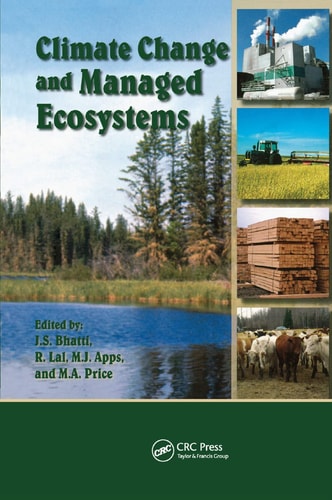
Climate Change and Managed Ecosystems
0
0
As an Amazon Associate and affiliate partner, Menrva Books earns from qualifying purchases. Learn more
Author Description
Featuring contributions from leading experts in the field, Climate Change and Managed Ecosystems examines the effects of global climate change on intensively constructed or reconstructed ecosystems, focusing on land use changes in relation to forestry, agriculture, and wetlands including peatlands. The book begins by discussing the fragility of ecosystems in the face of changing climates, particularly through human caused increases in atmospheric GHGs. The chapters delineate how and why the climate has changed and what can be expected to occur in the foreseeable future. They identify the potential adaptation responses to reduce the impacts of a changing climate. Using this information as a foundation, the chapter authors examine what is known about the impacts of climate on agricultural, forested, and wetland ecosystems. They illustrate the importance of these ecosystems in the global carbon cycle and discuss the potential interaction between terrestrial and atmospheric carbon pools under changing climactic conditions. The book delineates what needs to be done to ensure continued stability in these ecosystems. It includes a description of activities that have been undertaken in the past to identify gaps in understanding GHG emissions from agriculture, forests, and wetlands and their mitigation, as well as current research initiatives to address these gaps. The book presents an overview of how economic reasoning can be applied to climate change and illustrates how terrestrial carbon-uptake credits (offset credits) operate within the Kyoto Protocol framework. By identifying gaps in the current understanding of adaptation of mitigation strategies, the book underscores the need to make management of these ecosystems part of a global solution.
Menrva's Summary
THE THESIS
This book investigates the complex interactions between global climate change and intensively managed or reconstructed ecosystems, particularly focusing on land use changes within forestry, agriculture, and wetlands. The work begins by establishing the vulnerability of these ecosystems to climate shifts driven by human-induced greenhouse gas (GHG) increases. It then details the causes and projected future of climate change, alongside potential adaptation strategies. The core of the book examines the specific impacts of climate on agricultural, forested, and wetland environments, highlighting their critical role in the global carbon cycle and the potential interplay between terrestrial and atmospheric carbon pools.
THE SCOPE MAP
- Analysis of ecosystem fragility in the face of climate change and increased atmospheric GHGs.
- Explanation of the causes and future projections of climate change.
- Identification of potential adaptation responses to mitigate climate impacts.
- Detailed examination of climate impacts on agricultural ecosystems.
- Detailed examination of climate impacts on forested ecosystems.
- Detailed examination of climate impacts on wetland ecosystems, including peatlands.
- Discussion of the role of these ecosystems in the global carbon cycle and carbon pool interactions.
- Overview of past activities, current research, and identified knowledge gaps regarding GHG emissions and mitigation from agriculture, forests, and wetlands.
THE AUTHORITY PERSPECTIVE
The book presents a comprehensive overview of the impacts of climate change on managed ecosystems, drawing on expert contributions. It addresses the critical role of agriculture, forestry, and wetlands in the global carbon cycle and explores adaptation and mitigation strategies. The work also touches upon the economic dimensions of climate change, including carbon offset credits within the Kyoto Protocol framework. By identifying research gaps, the book emphasizes the necessity of integrating ecosystem management into global climate solutions.
Page Count:
464
Publication Date:
2019-09-11
Publisher:
CRC Press LLC
ISBN-10:
0367391481
ISBN-13:
9780367391485
Science
Non-Fiction
Climate Change
Ecosystems
Agriculture
Forestry
Land Use
Wetlands
Community Tags
Similar Books