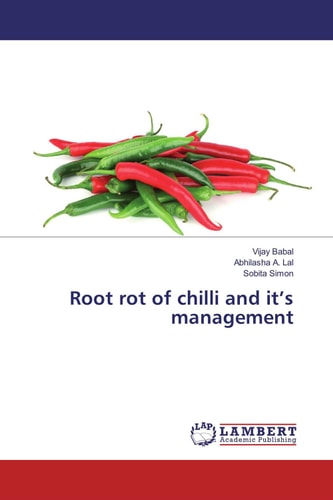
Root Rot of Chilli and Its Management
0
0
As an Amazon Associate and affiliate partner, Menrva Books earns from qualifying purchases. Learn more
Author Description
Chilli is considered a good source of vitamin C (ascorbic acid) in food and beverage industries.It is also source of vitamin A and E. Apart from these, small quantity of protein, fats, carbohydrates and traces of minerals are also present. It has also acquired a great importance because of the presence of 'oleoresin', which permits better distribution of color and flavor in foods. Root rot of chilli caused by Rhizoctonia solani is a very important fungal disease and cause losses.The root rot infected plants of chilli show yellowing and withering of upright foliage. The whole plant wilts and dry up later on. When pulled up, the root system is found to be partially or fully decayed. The infection extends up to lower portion of the stem at ground level and a dark brown discoloration of the affected portion of the stem can be seen.Due to indiscriminate use of chemicals for management of diseases has given rise to the risk of pollution and other hazardous effects.This book makes an attempt towards the use of bio-agents and plant leaf extracts for the management of the disease in an eco-friendly manner.In future use of bio-agents and botanicals may reduce the use of fungicides.
Menrva's Summary
THE THESIS
This book investigates eco-friendly methods for managing root rot in chili plants, a significant fungal disease caused by Rhizoctonia solani. The authors address the limitations of chemical fungicides, which pose risks of pollution and hazardous effects. Instead, the work focuses on the application of bio-agents and plant leaf extracts as sustainable alternatives for disease control. The research aims to reduce reliance on synthetic fungicides in the future by exploring these natural management strategies.
THE SCOPE MAP
- Nutritional and industrial importance of chili peppers.
- Identification and symptoms of root rot disease in chili plants caused by Rhizoctonia solani.
- Environmental and health risks associated with chemical fungicide use.
- Detailed exploration of bio-agents for disease management.
- Analysis of plant leaf extracts as natural fungicides.
- Potential for reducing synthetic fungicide use through eco-friendly alternatives.
THE AUTHORITY PERSPECTIVE
This text appears to be a focused scientific study detailing a specific agricultural problem and its potential solutions. The authors' approach, emphasizing bio-agents and plant extracts, suggests a commitment to sustainable and environmentally conscious agricultural practices. The book likely appeals to researchers, agronomists, and farmers seeking alternatives to conventional chemical treatments for crop diseases.
Page Count:
112
Publication Date:
2016-01-01
Publisher:
LAP Lambert Academic Publishing
ISBN-10:
3659937908
ISBN-13:
9783659937903
Science
Non-Fiction
Plant Pathology
Fungi
Agriculture
Community Tags
Similar Books