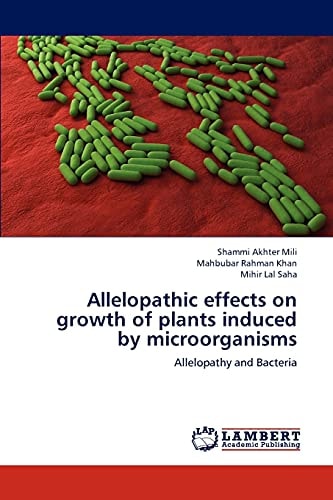
Allelopathic Effects on Growth of Plants Induced by Microorganisms
0
0
As an Amazon Associate and affiliate partner, Menrva Books earns from qualifying purchases. Learn more
Author Description
75 bacterial strains were isolated from different types of habitats and after preliminary screening, 12 strains were selected for study. Dilute culture filtrate showed different types of allelopathic effects on the rate of seed germination, and development of radicle and hypocotyl region of six different plant materials viz. Amaranthus sp., Amaranthus gangeticus L., Raphanus sativus L., Vigna mungo (L.) Hepper., Vinga radiata (L.) Wilizek and Lens esculenta Moench. Four bacterial strains (3LF-9, 3BF-2, SN-3 and SHP-4) showed significant inhibitory effect to seed germination of Raphanus sativus L., Amaranthus gangeticus L. and Amaranthus sp. One strain (2BF-3) reduced the length of radicle and hypocotyl of four different plant species viz. Raphanus sativus L., Vigna radiata (L.) Wilizek., Lens esculenta Moench. and Vigna mungo (L.) Hepper.). The strain 3WS-5 had stimulatory effect on seed germination and also on the length of radicle and hypocotyl of Raphanus sativus L. Strain 3CD-9 had similar effect on two plants viz. Vigna mungo (L.) Hepper. and Vinga radiata (L.) Wilizek.
Menrva's Summary
THE THESIS
This study investigates the allelopathic effects of isolated microorganisms on plant growth. The research details the isolation and screening of 75 bacterial strains from various habitats, ultimately selecting 12 for further study. The effects of dilute culture filtrates from these strains were observed on seed germination, radicle development, and hypocotyl elongation across six different plant species. Specific strains demonstrated significant inhibitory or stimulatory impacts, providing insights into microbial influence on plant physiology.
THE SCOPE MAP
- Isolation and preliminary screening of 75 bacterial strains from diverse habitats.
- Selection of 12 bacterial strains for detailed allelopathic effect studies.
- Testing of dilute culture filtrates on seed germination rates.
- Assessment of effects on radicle and hypocotyl development.
- Evaluation across six plant species: Amaranthus sp., Amaranthus gangeticus L., Raphanus sativus L., Vigna mungo (L.) Hepper., Vinga radiata (L.) Wilizek, and Lens esculenta Moench.
- Identification of four strains (3LF-9, 3BF-2, SN-3, SHP-4) with significant inhibitory effects on specific plant species.
- Identification of strain 2BF-3 with inhibitory effects on radicle and hypocotyl length for four plant species.
- Identification of strain 3WS-5 with stimulatory effects on seed germination and growth for Raphanus sativus L.
- Identification of strain 3CD-9 with stimulatory effects on Vigna mungo (L.) Hepper. and Vinga radiata (L.) Wilizek.
THE AUTHORITY PERSPECTIVE
This research paper presents a focused study on the allelopathic interactions between specific bacterial strains and various crop plants. The detailed methodology and results, including the identification of inhibitory and stimulatory strains, suggest a contribution to the understanding of microbial influences in agricultural and ecological contexts. The findings are likely of interest to researchers in plant pathology, soil microbiology, and agronomy seeking to leverage microbial properties for crop improvement or weed management.
Page Count:
120
Publication Date:
2012-08-01
Publisher:
Lap Lambert Academic Publishing GmbH KG
ISBN-10:
3659199834
ISBN-13:
9783659199837
Science
Non-Fiction
Microbiology
Biology
Botany
Agriculture
Scientific Research
Community Tags
Similar Books