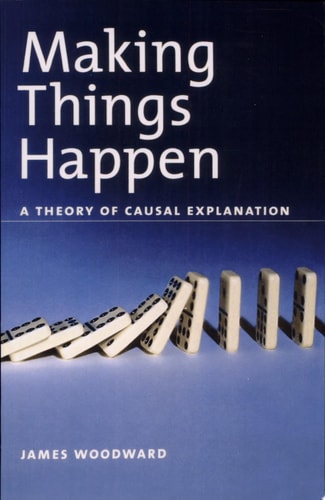
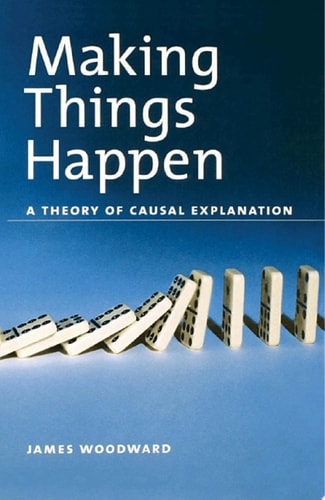
Making Things Happen: A Theory of Causal Explanation
0
0
As an Amazon Associate and affiliate partner, Menrva Books earns from qualifying purchases. Learn more
Author Description
In Making Things Happen, James Woodward develops a new and ambitious comprehensive theory of causation and explanation that draws on literature from a variety of disciplines and which applies to a wide variety of claims in science and everyday life. His theory is a manipulationist account, proposing that causal and explanatory relationships are relationships that are potentially exploitable for purposes of manipulation and control. This account has its roots in the commonsense idea that causes are means for bringing about effects; but it also draws on a long tradition of work in experimental design, econometrics, and statistics.Woodward shows how these ideas may be generalized to other areas of science from the social scientific and biomedical contexts for which they were originally designed. He also provides philosophical foundations for the manipulationist approach, drawing out its implications, comparing it with alternative approaches, and defending it from common criticisms. In doing so, he shows how the manipulationist account both illuminates important features of successful causal explanation in the natural and social sciences, and avoids the counterexamples and difficulties that infect alternative approaches, from the deductive-nomological model onwards.Making Things Happen will interest philosophers working in the philosophy of science, the philosophy of social science, and metaphysics, and as well as anyone interested in causation, explanation, and scientific methodology.
Menrva's Summary
THE THESIS
This work investigates the core question of how causal and explanatory relationships function within scientific and everyday contexts through a manipulationist framework. James Woodward, a prominent philosopher of science, synthesizes concepts from experimental design, econometrics, and statistics to propose that causation is fundamentally linked to the potential for manipulation and control. By moving beyond traditional deductive-nomological models, he establishes a robust philosophical foundation that accounts for causal explanation across the natural and social sciences.
THE SCOPE MAP
What You Will Find
- A comprehensive manipulationist theory of causal explanation.
- Integration of methodologies from econometrics and experimental design.
- Comparative analysis between the manipulationist approach and alternative philosophical models.
- Application of causal theory to social scientific and biomedical research.
THE AUTHORITY PERSPECTIVE
Experts recognize this text as a foundational contribution to contemporary philosophy of science and causal metaphysics. Readers frequently note the academic density of the prose, which requires a strong background in formal logic and scientific methodology to fully navigate.
Page Count:
432
Publication Date:
2005-10-27
Publisher:
Oxford University Press
ISBN-10:
0195189531
ISBN-13:
9780195189537
Philosophy
Science
Causation
Logic
Epistemology
Science
Metaphysics
Community Tags
Other Editions(3)
Similar Books