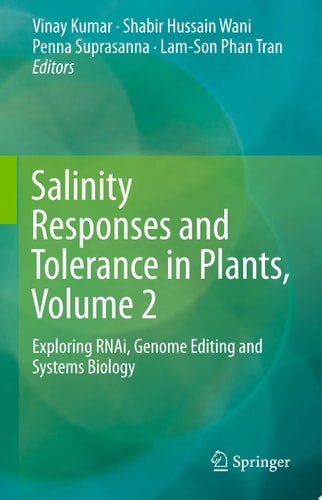
Salinity Responses and Tolerance in Plants, Volume 2
0
0
As an Amazon Associate and affiliate partner, Menrva Books earns from qualifying purchases. Learn more
Author Description
Soil salinity is a key abiotic-stress and poses serious threats to crop yields and quality of produce. Owing to the underlying complexity, conventional breeding programs have met with limited success. Even genetic engineering approaches, via transferring/overexpressing a single ‘direct action gene’ per event did not yield optimal results. Nevertheless, the biotechnological advents in last decade coupled with the availability of genomic sequences of major crops and model plants have opened new vistas for understanding salinity-responses and improving salinity tolerance in important glycophytic crops. Our goal is to summarize these findings for those who wish to understand and target the molecular mechanisms for producing salt-tolerant and high-yielding crops. Through this 2-volume book series, we critically assess the potential venues for imparting salt stress tolerance to major crops in the post-genomic era. Accordingly, perspectives on improving crop salinity tolerance by targeting the sensory, ion-transport and signaling mechanisms were presented in Volume 1. Volume 2 now focuses on the potency of post-genomic era tools that include RNAi, genomic intervention, genome editing and systems biology approaches for producing salt tolerant crops.
Menrva's Summary
THE THESIS
Soil salinity presents a significant challenge to global crop production, threatening yields and quality, with conventional and even some genetic engineering approaches yielding limited success. This two-volume series aims to consolidate recent advancements in understanding and improving salinity tolerance in crops. Volume 1 focused on sensory, ion-transport, and signaling mechanisms, while this volume, Volume 2, delves into the application of post-genomic era tools. The objective is to provide insights for researchers and breeders seeking to develop salt-tolerant, high-yielding crops by targeting molecular mechanisms.
THE SCOPE MAP
- Applications of RNAi technology for salinity tolerance.
- Strategies involving genomic intervention and genome editing.
- The role of systems biology in understanding plant responses to salt stress.
- Discussion of molecular mechanisms for enhancing salt tolerance in glycophytic crops.
THE AUTHORITY PERSPECTIVE
This volume is presented as a critical assessment of post-genomic era tools for improving crop salinity tolerance, building upon the foundational concepts discussed in Volume 1. The focus on advanced biotechnological approaches like RNAi, genomic intervention, and systems biology suggests a text aimed at researchers and specialists in plant science and agriculture. The content is likely to be technical, detailing molecular mechanisms and genetic strategies for developing salt-tolerant crops in the current era of genomic availability.
Page Count:
326
Publication Date:
2018-06-22
Publisher:
Springer Nature
ISBN-10:
3319903187
ISBN-13:
9783319903187
Non-Fiction
Science
Genetics
Plant Science
Agriculture
Botany
Biotechnology
Community Tags
Similar Books














