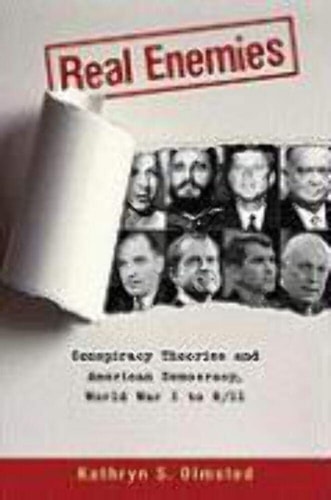
Real Enemies: Conspiracy Theories and American Democracy, World War I to 9/11
0
0
As an Amazon Associate and affiliate partner, Menrva Books earns from qualifying purchases. Learn more
Author Description
Many Americans believe that their own government is guilty of shocking crimes. Government agents shot the president. They faked the moon landing. They stood by and allowed the murders of 2,400 servicemen in Hawaii. Although paranoia has been a feature of the American scene since the birth of the Republic, in Real Enemies Kathryn Olmsted shows that it was only in the twentieth century that strange and unlikely conspiracy theories became central to American politics. In particular, she posits World War I as a critical turning point and shows that as the federal bureaucracy expanded, Americans grew more fearful of the government itself--the military, the intelligence community, and even the President. Analyzing the wide-spread suspicions surrounding such events as Pearl Harbor, the JFK assassination, Watergate, and 9/11, Olmsted sheds light on why so many Americans believe that their government conspires against them, why more people believe these theories over time, and how real conspiracies--such as the infamous Northwoods plan--have fueled our paranoia about the governments we ourselves elect.
Menrva's Summary
THE THESIS
This book investigates why conspiracy theories regarding the federal government became a central feature of American political life during the twentieth century. Kathryn S. Olmsted, a professor of history, utilizes archival research and historical analysis to argue that the expansion of the federal bureaucracy and the occurrence of genuine government conspiracies created a fertile environment for public distrust. She examines how the growth of the military and intelligence communities, coupled with specific historical events, fundamentally altered the relationship between the American public and their elected officials.
THE SCOPE MAP
What You Will Find
- Historical analysis of major events including Pearl Harbor, the JFK assassination, Watergate, and 9/11.
- Examination of the transition from early American paranoia to modern institutional distrust.
- Documentation of verified government conspiracies, such as the Northwoods plan, as catalysts for public suspicion.
- Evaluation of the impact of an expanding federal bureaucracy on democratic engagement.
THE AUTHORITY PERSPECTIVE
Experts and historians frequently cite this work as a balanced and essential examination of the intersection between political reality and public perception. Readers often note the clarity of the prose, which makes complex historical developments accessible to both academic and general audiences.
Page Count:
336
Publication Date:
2009-01-02
Publisher:
Oxford University Press
ISBN-10:
0195183533
ISBN-13:
9780195183535
Politics
History
American History
Deception
Democracy history
Americas
Conspiracy theories
Categories
Kindle eBooks
Sociology
Kindle Store
Community Tags
Other Editions(3)


Similar Books