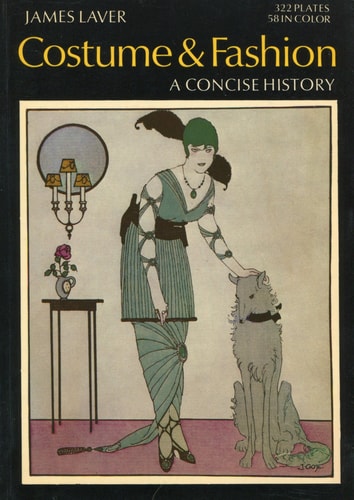
Costume and Fashion: A Concise History
0
0
As an Amazon Associate and affiliate partner, Menrva Books earns from qualifying purchases. Learn more
Author Description
The vagaries of fashion throughout the ages are a source of endless interest, not only as indication of our infinite capacity for invention, but also because of the relationship of costume to shifting cultural patterns. Laver presents in this classic study the underlying motives of fashion as well as a survey of the history of costume. He describes the means which have been adopted to satisfy the three functions of clothes: protection, expression of the personality by sartorial display, and attractiveness to others. The momentous invention of the needle (some 40,000 years ago), making possible the sewing together of pelts, and the subsequent introduction of weaving, launched the development of costume as we know it. All the major historical landmarks -- the Renaissance, the French Revolution, the Industrial Revolution, the emancipation of women, the two world wars -- wrought profound changes in attitudes to dress: with matchless skill and panache Laver related the development of costume and fashion to these social changes. A new final chapter by Christina Probert brings the history up to the present day [sic] with a detailed discussion of the enormous variety of postwar styles, including the New Look, the mini, and punk-influenced clothes. James Laver (1899-1975) was keeper of the Departments of Prints and Drawings and of Paintings at the Victoria and Albert Museum, London, from 1938 until 1959. He was also an important and pioneering fashion historian described as “the man in England who made the study of costume respectable”. Laver is perhaps best remembered for his contributions to the field of fashion history, an interest in which emerged through a desire to date images accurately through the clothing depicted within. Laver defined the relationships between dress design and other applied arts, and discussed the influence of economic and social factors upon the development of fashionable taste.
Menrva's Summary
THE THESIS
This text investigates the evolution of human dress as a reflection of shifting cultural patterns, psychological motives, and social history. James Laver, a former keeper at the Victoria and Albert Museum, utilizes his extensive background in art history to analyze the primary functions of clothing: protection, personal expression, and social attraction. The book argues that fashion is not merely aesthetic but a direct consequence of economic, technological, and political developments throughout human history.
THE SCOPE MAP
What You Will Find
- A chronological survey of costume development from the invention of the needle to the late 20th century.
- Analysis of the three primary functions of clothing: protection, display, and attraction.
- Examination of major historical milestones including the Renaissance, the French Revolution, and the Industrial Revolution.
- Discussion of postwar fashion trends such as the New Look, the mini skirt, and punk-influenced styles.
THE AUTHORITY PERSPECTIVE
Experts recognize this work as a foundational text in the field of fashion history, noting its role in establishing costume study as a respectable academic discipline. Readers frequently highlight the clarity of Laver's prose and his ability to synthesize complex social history with the evolution of sartorial design.
Page Count:
288
Publication Date:
1983-01-01
Publisher:
Oxford University Press
ISBN-10:
0195203909
ISBN-13:
9780195203905
History
Costume history
Sociology
Art History
Design
Fashion
Community Tags
Other Editions(2)

Similar Books




Reader Comments
Share Your Thoughts
No comments yet. Be the first to share your thoughts!