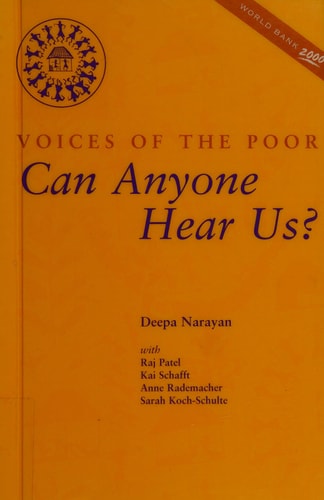
Can Anyone Hear Us?: Voices of the Poor
0
0
As an Amazon Associate and affiliate partner, Menrva Books earns from qualifying purchases. Learn more
Author Description
First in a group of three volumes resulting from a global consultation and research effort. multi-country research initiative to understand poverty from the eyes of the poor, the 'Voices of the Poor' project was undertaken to inform the World Bank's activities and the 'World Development Report 2000/2001'. 'Voices of the Poor' marks the first time such an exercise has been undertaken in so many developing countries and transition economies around the world. ― Volume 1, 'Can Anyone Hear Us?' gathers the voices of over 40,000 poor women and men in 50 countries from the World Bank's participatory poverty assessments (Deepa Narayan, Raj Patel, Kai Schafft, Anne Rademacher, and Sarah Koch-Schulte, authors). ― Volume 2, 'Crying Out for Change' pulls together new field work conducted in 1999 in 23 countries (Deepa Narayan, Robert Chambers, Meera Shah, and Patti Petesch, authors). ― Volume 3, 'From Many Lands' offers regional patterns and country case-studies (Deepa Narayan and Patti Petesch, editors). 'Voices of the Poor' provides a unique and detailed picture of the life of the poor and explains the constraints poor people face to escape from poverty in a way that more traditional survey techniques do not capture well. Each of the three volumes demonstrates the importance of voice and power in poor people's definition of poverty. 'Voices of the Poor' concludes that we need to expand our conventional views of poverty which focus on income expenditure, education, and health to include measures of voice and empowerment. A copublication of the World Bank and Oxford University Press.
Menrva's Summary
THE THESIS
This volume investigates the lived experience of poverty by prioritizing the direct perspectives of the impoverished over traditional quantitative economic metrics. The authors, a team of researchers associated with the World Bank, utilize extensive participatory poverty assessments to challenge conventional development frameworks. By synthesizing qualitative data from 40,000 individuals across 50 countries, the work argues that poverty is defined not merely by income or health statistics, but by a fundamental lack of voice and power within social and political systems.
THE SCOPE MAP
What You Will Find
- Qualitative data derived from participatory poverty assessments conducted in 50 developing and transition economies.
- A comparative analysis of the constraints identified by poor populations as primary barriers to economic mobility.
- A methodological framework for integrating subjective human experience into institutional development policy.
- Evidence-based arguments for expanding poverty definitions to include empowerment and social agency.
THE AUTHORITY PERSPECTIVE
Experts and development practitioners recognize this work as a foundational text for shifting the focus of international aid toward participatory research methods. Readers frequently note the density of the qualitative data, which provides a necessary human dimension to the World Bank's broader economic reports.
Page Count:
360
Publication Date:
2000-03-01
Publisher:
World Bank Publications
ISBN-10:
0195216016
ISBN-13:
9780195216011
Economics
Social Science
Poor
Sociology
Poverty
Community Tags
Similar Books