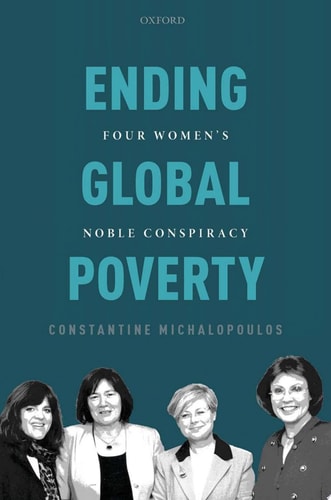
Ending Global Poverty: Four Women's Noble Conspiracy
0
0
As an Amazon Associate and affiliate partner, Menrva Books earns from qualifying purchases. Learn more
Author Description
Ending poverty continues to be a major challenge for the global community. It is even more urgent and relevant today when the world is facing the covid-19 pandemic as it was two decades ago, when four women rose to prominent positions as ministers in charge of international development in their governments. Ending Global Poverty: Four Women's Noble Conspiracy tells the story of Eveline Herfkens from the Netherlands, Hilde F. Johnson from Norway, Clare Short from the United Kingdom, and Heidemarie Wieczorek-Zeul from Germany who joined forces to challenge the establishment policies of international institutions.Named for the Norwegian Abbey where the formalized their collaboration in 1999, the so-called Utstein Four embarked on a 'conspiracy of implementation', using foreign aid as a tool to end global poverty, rather than pursue narrow political or commercial interests. They helped achieve primary education for women, used developing countries' debt relief to lift individuals out of poverty, and put development partners in charge of setting priorities and implementing programs of assistance. Their story of female empowerment and the importance of working together is a crucial lesson, and Ending Global Poverty focuses on the implications of this for today's development challenges, including the struggle to achieve the 2030 Sustainable Development Goals which is becoming more difficult every day.The Utstein Four's collaboration lasted for only about half a dozen years but their influence continues to be felt. Much has been achieved but some lessons have been forgotten and large new challenges remain.Ending Global Poverty: Four Women's Nobel Conspiracy considers the lasting legacy of the Utstein group and the lessons that their experience of commitment, collaboration and leadership offers to a new generation of leaders as they work to eradicate global poverty and achieve sustainable development.
Menrva's Summary
THE THESIS
This book investigates the efficacy of collaborative international development policy by examining the 'Utstein Four' and their efforts to reshape global aid strategies. Constantine Michalopoulos, an expert in international development, utilizes historical records and the specific experiences of four female ministers to argue that coordinated, altruistic policy-making can successfully challenge entrenched institutional interests. The text provides a framework for understanding how leadership and cooperation can be leveraged to address systemic poverty and meet modern sustainable development goals.
THE SCOPE MAP
What You Will Find
- A detailed historical account of the Utstein group's formation in 1999 and their subsequent policy initiatives.
- Analysis of the 'conspiracy of implementation' methodology used to prioritize humanitarian aid over commercial interests.
- Case studies regarding debt relief, primary education for women, and the decentralization of development priorities.
- Lessons on leadership and cross-national collaboration applicable to current global challenges like the 2030 Sustainable Development Goals.
THE AUTHORITY PERSPECTIVE
Experts and readers recognize this work as a significant contribution to the history of international development policy. The text is frequently cited for its clear documentation of how political collaboration can influence large-scale institutional change.
Page Count:
304
Publication Date:
2020-06-06
Publisher:
Oxford University Press
ISBN-10:
0198850174
ISBN-13:
9780198850175
Economics
History
Biography
International Development
Economic History
BASIC Needs
Poor
Social Science
Social planning
Poverty
Community Tags
Similar Books