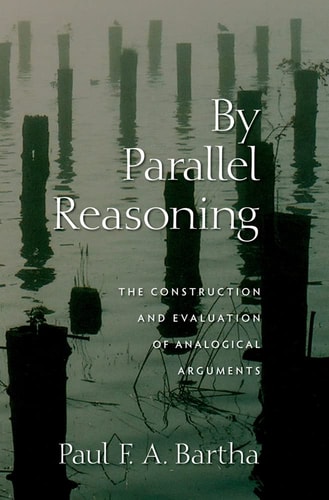
By Parallel Reasoning
0
0
As an Amazon Associate and affiliate partner, Menrva Books earns from qualifying purchases. Learn more
Author Description
By Parallel Reasoning is the first comprehensive philosophical examination of analogical reasoning in more than forty years designed to formulate and justify standards for the critical evaluation of analogical arguments. It proposes a normative theory with special focus on the use of analogies in mathematics and science.In recent decades, research on analogy has been dominated by computational theories whose objective has been to model analogical reasoning as a psychological process. These theories have devoted little attention to normative questions. In this book Bartha proposes that a good analogical argument must articulate a clear relationship that is capable of generalization. This idea leads to a set of distinct models for the critical analysis of prominent forms of analogical argument. The same core principle makes it possible to relate analogical reasoning to norms and values of scientific practice. Reasoning by analogy is justified because it strikes an optimal balance between conservative values, such as simplicity and coherence, and progressive values, such as fruitfulness and theoretical unification. Analogical arguments are also justified by appeal to symmetry--like cases are to be treated alike.In elaborating the connection between analogy and these broad epistemic principles, By Parallel Reasoning offers a novel contribution to explaining how analogies can play an important role in the confirmation of scientific hypotheses
Menrva's Summary
THE THESIS
This book investigates the logical foundations and normative standards required to evaluate the validity of analogical arguments in scientific and mathematical contexts. Paul Bartha, a philosopher of science, addresses the historical gap in normative theory by moving beyond purely psychological or computational models of analogy. He argues that a robust analogical argument must rely on a clear, generalizable relationship between cases, grounded in epistemic principles such as symmetry, simplicity, and theoretical fruitfulness. By establishing these criteria, the author provides a framework for determining when an analogy serves as a legitimate tool for hypothesis confirmation.
THE SCOPE MAP
What You Will Find
- A normative theory for the critical evaluation of analogical arguments.
- Comparative analysis between computational psychological models and philosophical logical models.
- Application of symmetry principles to justify analogical reasoning in scientific practice.
- A framework balancing conservative epistemic values like coherence with progressive values like fruitfulness.
THE AUTHORITY PERSPECTIVE
Experts recognize this work as a foundational text for those studying the intersection of logic and scientific methodology. Readers frequently note the academic density of the prose, which is intended for scholars and students of philosophy rather than a general audience.
Page Count:
376
Publication Date:
2010-03-17
Publisher:
Oxford University Press
ISBN-10:
0195325532
ISBN-13:
9780195325539
Philosophy
Science
Logic
Reasoning
Analogy
Mathematics
Epistemology
Community Tags
Similar Books