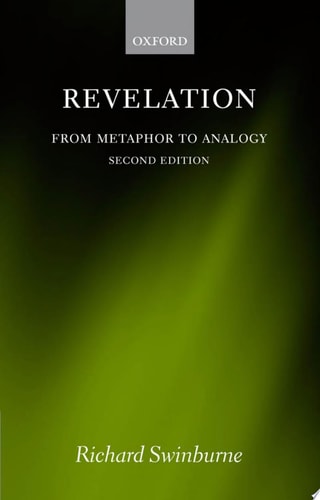
Revelation: From Metaphor to Analogy
0
0
As an Amazon Associate and affiliate partner, Menrva Books earns from qualifying purchases. Learn more
Author Description
The great religions often claim that their books or creeds contain truths revealed by God. How could we know that they do? In the second edition of Revelation, renowned philosopher of religion Richard Swinburne addresses this central question. But since the books of great religions often contain much poetry and parable, Swinburne begins by investigating how eternal truth can be conveyed in unfamiliar genres, by analogy and metaphor, within false presuppositions about science and history. In the final part of the book, Swinburne then applies the results of Parts I and II to assessing the evidence that the teaching of the Christian Church constitutes a revelation from God.In the course of his philosophical exploration, Swinburne considers how the church which Jesus founded is to be identified today and presents a sustained discussion of which passages in the Bible should be understood literally and which should be understood metaphorically.This is a fuller and entirely rewritten second edition of Revelation, the most notable new feature of which is a long chapter examining whether traditional Christian claims about personal morality (divorce, homosexuality, abortion, etc.) can be regarded as revealed truths. A formal appendix shows how the structure of evidence supporting the Christian revelation can be articulated in terms of the probability calculus (and shows that Plantinga's well-known argument from "dwindling probabilities" against probabilistic arguments of this kind is not cogent).
Menrva's Summary
THE THESIS
This work investigates the epistemological criteria required to determine if religious texts and creeds constitute genuine divine revelation. Richard Swinburne, a prominent philosopher of religion, utilizes a rigorous analytical framework to examine how eternal truths are communicated through metaphor, parable, and historical context. By applying probability calculus to theological claims, he evaluates the evidence supporting the teachings of the Christian Church and addresses the validity of traditional moral doctrines.
THE SCOPE MAP
What You Will Find
- Analysis of linguistic modes including metaphor, analogy, and literal interpretation within sacred texts.
- Application of probability theory to assess the strength of evidence for divine revelation.
- Evaluation of contemporary moral issues such as divorce, homosexuality, and abortion through a theological lens.
- A formal critique of Alvin Plantinga’s arguments regarding the limitations of probabilistic evidence in religious discourse.
THE AUTHORITY PERSPECTIVE
Scholars and students of analytic philosophy of religion frequently identify this text as a rigorous, systematic defense of Christian revelation. Readers often note the high level of technical density, particularly in the sections utilizing probability calculus to evaluate theological truth claims.
Page Count:
304
Publication Date:
2007-09-06
Publisher:
Clarendon Press
ISBN-10:
0199212465
ISBN-13:
9780199212460
Philosophy
Religion
Epistemology
Theology
Revelation
Christianity
Analogy
Metaphor
Community Tags
Similar Books