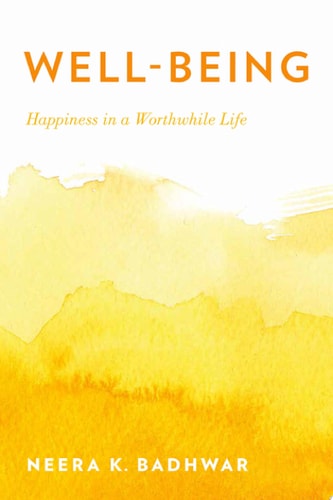
Well-Being: Happiness in a Worthwhile Life
0
0
As an Amazon Associate and affiliate partner, Menrva Books earns from qualifying purchases. Learn more
Author Description
This book offers a new argument for the ancient claim that well-being as the highest prudential good -- eudaimonia -- consists of happiness in a virtuous life. The argument takes into account recent work on happiness, well-being, and virtue, and defends a neo-Aristotelian conception of virtue as an integrated intellectual-emotional disposition that is limited in both scope and stability. This conception of virtue is argued to be widely-held and compatible with social and cognitive psychology.The main argument of the book is as follows: (i) the concept of well-being as the highest prudential good is internally coherent and widely held; (ii) well-being conceived thus requires an objectively worthwhile life; (iii) in turn, such a life requires autonomy and reality-orientation, i.e., a disposition to think for oneself, seek truth or understanding about important aspects of one's own life and human life in general, and act on this understanding when circumstances permit; (iv) to the extent that someone is successful in achieving understanding and acting on it, she is realistic, and to the extent that she is realistic, she is virtuous; (v) hence, well-being as the highest prudential good requires virtue. But complete virtue is impossible for both psychological and epistemic reasons, and this is one reason why complete well-being is impossible.
Menrva's Summary
THE THESIS
This book investigates the philosophical question of whether well-being, or eudaimonia, is fundamentally tied to the pursuit of a virtuous life. Neera K. Badhwar, a philosopher specializing in ethics and political philosophy, synthesizes neo-Aristotelian thought with contemporary findings in social and cognitive psychology. She argues that well-being requires an objectively worthwhile life, which in turn necessitates autonomy and a commitment to reality-orientation. By examining the limitations of human psychology and epistemology, the author posits that while complete virtue is unattainable, it remains the essential component of a life well-lived.
THE SCOPE MAP
What You Will Find
- A neo-Aristotelian framework defining virtue as an integrated intellectual-emotional disposition.
- An analysis of the relationship between autonomy, reality-orientation, and personal well-being.
- A critical synthesis of modern psychological research regarding happiness and human flourishing.
- A logical progression arguing why complete well-being is an ideal rather than a fully achievable state.
THE AUTHORITY PERSPECTIVE
Scholars and students of moral philosophy frequently cite this work for its rigorous integration of classical virtue ethics with modern empirical data. Experts highlight the text as a significant contribution to the ongoing academic discourse regarding the objective requirements of a flourishing life.
Page Count:
264
Publication Date:
2014-07-02
Publisher:
Oxford University Press
ISBN-10:
0195323270
ISBN-13:
9780195323276
Psychology
Non-Fiction
Philosophy
Ethics
Conduct Of Life
Happiness
Community Tags
Similar Books