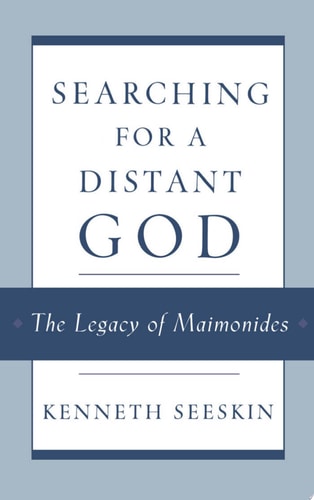
Searching for a Distant God: The Legacy of Maimonides
0
0
As an Amazon Associate and affiliate partner, Menrva Books earns from qualifying purchases. Learn more
Author Description
Monotheism is usually considered Judaism's greatest contribution to world culture, but it is far from clear what monotheism is. This work examines the notion that monotheism is not so much a claim about the number of God as a claim about the nature of God. Seeskin argues that the idea of a God who is separate from his creation and unique is not just an abstraction but a suitable basis for worship. He examines this conclusion in the contexts of prayer, creation, sabbath observance, repentance, religious freedom, and love of God. Maimonides plays a central role in the argument both because of his importance to Jewish self-understanding and because he deals with the question of how philosophic ideas are embodied in religious ritual.
Menrva's Summary
THE THESIS
This work investigates the fundamental definition of monotheism by arguing that it represents a claim about the nature of God rather than merely a numerical count of deities. Kenneth Seeskin, a scholar of Jewish philosophy, utilizes the writings of Maimonides to bridge the gap between abstract philosophical concepts and the practical requirements of religious life. By positioning Maimonides as a central figure, the author demonstrates how the concept of a unique, transcendent God serves as a coherent foundation for worship and ethical practice within the Jewish tradition.
THE SCOPE MAP
What You Will Find
- An analysis of Maimonides' philosophical framework regarding divine transcendence.
- A thematic examination of religious rituals including prayer, repentance, and sabbath observance.
- A discussion on the intersection of religious freedom and the love of God.
- A philosophical inquiry into how abstract theological ideas manifest in concrete religious behavior.
THE AUTHORITY PERSPECTIVE
Scholars and students of medieval philosophy frequently cite this text for its clear articulation of Maimonidean thought. The prose is noted for its accessibility while maintaining the rigor required for academic theological study.
Page Count:
264
Publication Date:
2000-01-01
Publisher:
Oxford University Press
ISBN-10:
0195344081
ISBN-13:
9780195344080
History
Religion
Philosophy
Judaism
Jewish philosophy
Theology
Community Tags
Similar Books