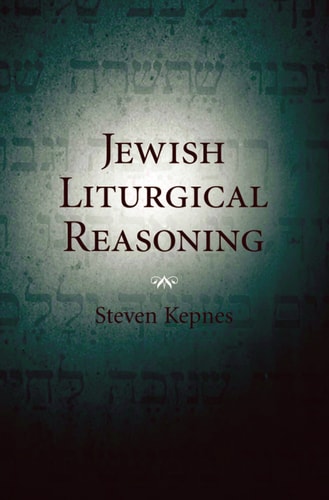
Jewish Liturgical Reasoning
0
0
As an Amazon Associate and affiliate partner, Menrva Books earns from qualifying purchases. Learn more
Author Description
Liturgy, a complex interweaving of word, text, song, and behavior is a central fixture of religious life in the Jewish tradition. It is unique in that it is performed and not merely thought. Because liturgy is performed by a specific group at a specific time and place it is mutable. Thus, liturgical reasoning is always new and understandings of liturgical practices are always evolving. Liturgy is neither preexisting nor static; it is discovered and revealed in every liturgical performance. Jewish Liturgical Reasoning is an attempt to articulate the internal patterns of philosophical, ethical, and theological reasoning that are at work in synagogue liturgies. This book discusses the relationship between internal Jewish liturgical reasoning and the variety of external philosophical and theological forms of reasoning that have been developed in modern and post liberal Jewish philosophy. Steven Kepnes argues that liturgical reasoning can reorient Jewish philosophy and provide it with new tools, new terms of discourse and analysis, and a new sensibility for the twenty-first century. The formal philosophical study of Jewish liturgy began with Moses Mendelssohn and the modern Jewish philosophers. Thus the book focuses, in its first chapters, on the liturgical reasoning of Moses Mendelssohn, Hermann Cohen, and Franz Rosenzweig. However, it attempts to augment and further develop the liturgical reasoning of these figures with methods of study from Hermeneutics, Semiotic theory, post liberal theology, anthropology and performance theory. These newer theories are enlisted to help form a contemporary liturgical reasoning that can respond to such events as the Holocaust, the establishment of the State of Israel, and interfaith dialogue between Jews, Christians, and Muslims.
Menrva's Summary
THE THESIS
This book investigates how the internal patterns of philosophical, ethical, and theological reasoning within Jewish liturgy can be articulated and applied to contemporary discourse. Steven Kepnes, a scholar of Jewish thought, examines the performative nature of liturgy as a dynamic, evolving process rather than a static text. By integrating historical philosophical perspectives with modern methodologies, he argues that liturgical reasoning offers a framework to reorient Jewish philosophy for the twenty-first century.
THE SCOPE MAP
What You Will Find
- Analysis of liturgical reasoning in the works of Moses Mendelssohn, Hermann Cohen, and Franz Rosenzweig
- Integration of methodologies from hermeneutics, semiotic theory, and performance theory
- Application of liturgical reasoning to modern events including the Holocaust and the establishment of the State of Israel
- Exploration of interfaith dialogue between Jews, Christians, and Muslims
Scope Limits
- The text does not provide a comprehensive history of all Jewish liturgical rites
- It does not serve as a practical guide for conducting synagogue services
THE AUTHORITY PERSPECTIVE
Scholars and theologians identify this work as a significant contribution to the intersection of Jewish philosophy and liturgical studies. Readers frequently note the academic density of the prose, which requires a foundational understanding of modern Jewish philosophy to fully engage with the author's arguments.
Page Count:
248
Publication Date:
2007-01-01
Publisher:
Oxford University Press
ISBN-10:
0190295325
ISBN-13:
9780190295325
Philosophy
Religion
Prayer_judaism
Jewish philosophy
Theology
Judaism
Community Tags
Other Editions(4)

Similar Books

Reader Comments
Share Your Thoughts
No comments yet. Be the first to share your thoughts!