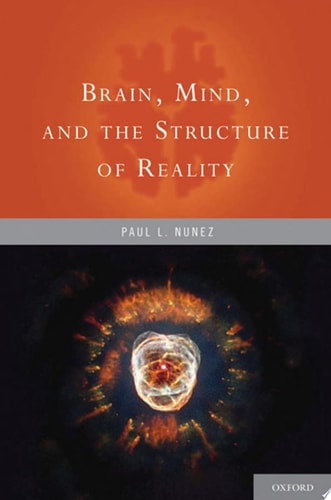
Brain, Mind, and the Structure of Reality
0
0
As an Amazon Associate and affiliate partner, Menrva Books earns from qualifying purchases. Learn more
Author Description
Does the brain create the mind, or is some external entity involved? In addressing this "hard problem" of consciousness, we face a central human challenge: what do we really know and how do we know it? Tentative answers in this book follow from a synthesis of profound ideas, borrowed from philosophy, religion, politics, economics, neuroscience, physics, mathematics, and cosmology, the knowledge structures supporting our meager grasps of reality. This search for new links in the web of human knowledge extends in many directions: the "shadows" of our thought processes revealed by brain imagining, brains treated as complex adaptive systems that reveal fractal-like behavior in the brain's nested hierarchy, resonant interactions facilitating functional connections in brain tissue, probability and entropy as measures of human ignorance, fundamental limits on human knowledge, and the central role played by information in both brains and physical systems.In Brain, Mind, and the Structure of Reality, Paul Nunez discusses the possibility of deep connections between relativity, quantum mechanics, thermodynamics, and consciousness: all entities involved with fundamental information barriers. Dr. Nunez elaborates on possible new links in this nested web of human knowledge that may tell us something new about the nature and origins of consciousness. In the end, does the brain create the mind? Or is the Mind already out there? You decide.
Menrva's Summary
THE THESIS
This book investigates the fundamental relationship between the physical brain and the phenomenon of consciousness, questioning whether the mind is a product of biological processes or an external entity. Paul L. Nunez, a neuroscientist, synthesizes concepts from diverse disciplines including quantum mechanics, thermodynamics, and cosmology to construct a framework for understanding human knowledge. He argues that by examining information barriers and complex adaptive systems, we may uncover new links between the physical structure of the brain and the nature of reality.
THE SCOPE MAP
What You Will Find
- Analysis of brain imaging data and fractal-like behavior in neural hierarchies
- Exploration of resonant interactions within brain tissue
- Application of probability and entropy to measure human knowledge limits
- Synthesis of relativity, quantum mechanics, and information theory in relation to consciousness
THE AUTHORITY PERSPECTIVE
Readers frequently note the high level of academic density and the interdisciplinary breadth of the prose. Experts highlight this as a challenging text that encourages readers to bridge the gap between hard science and philosophical inquiry.
Page Count:
306
Publication Date:
2010-04-07
Publisher:
Oxford University Press
ISBN-10:
019534071X
ISBN-13:
9780195340716
Philosophy
Science
Neuroscience
Physics
Consciousness
Community Tags
Other Editions(2)
Similar Books