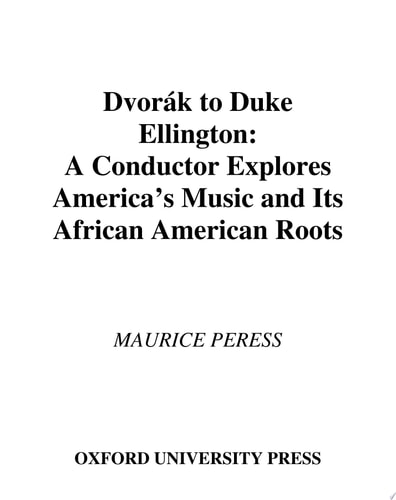
Dvorák to Duke Ellington: A Conductor Explores America's Music and Its African American Roots
0
0
As an Amazon Associate and affiliate partner, Menrva Books earns from qualifying purchases. Learn more
Author Description
Drawing upon a remarkable mix of intensive research and the personal experience of a career devoted to the music about which Dvorák so presciently spoke, Maurice Peress's lively and convincing narrative treats readers to a rare and delightful glimpse behind the scenes of the burgeoning American school of music and beyond.In Dvorák to Duke Ellington, Peress begins by recounting the music's formative years: Dvorák's three year residency as Director of the National Conservatory of Music in New York (1892-1895), and his students, in particular Will Marion Cook and Rubin Goldmark, who would in turn become the teachers of Ellington, Gershwin, and Copland. We follow Dvorák to the famed Chicago World's Fair of 1893, where he directed a concert of his music for Bohemian Honor Day. Peress brings to light the little known African American presence at the Fair: the piano professors, about-to-be-ragtimers; and the gifted young artists Paul Dunbar, Harry T. Burleigh, and Cook, who gathered at the Haitian Pavilion with its director, Frederick Douglass, to organize their own gala concert for Colored Persons Day.Peress, a distinguished conductor, is himself a part of this story; working with Duke Ellington on the Suite from Black, Brown and Beige and his "opera comique," Queenie Pie; conducting the world premiere of Leonard Bernstein's Mass; and reconstructing landmark American concerts at which George Antheil's Ballet Mecanique, George Gershwin's Rhapsody in Blue, James Reese Europe's Clef Club (the first all-black concert at Carnegie Hall), and Ellington's Black, Brown and Beige, were first presented. Concluding with an astounding look at Ellington and his music, Dvorák to Duke Ellington offers an engrossing, elegant portrait of the Dvorák legacy, America's music, and the inestimable African-American influence upon it.
Menrva's Summary
THE THESIS
How did the intersection of European classical traditions and African American musical innovation shape the development of a distinct American sound? Maurice Peress, a distinguished conductor with a career spanning decades of American musical performance, utilizes his unique position as both a scholar and a practitioner to trace this lineage. He argues that the influence of Antonín Dvořák during his American residency provided a foundational catalyst for subsequent generations of composers, including Duke Ellington, George Gershwin, and Aaron Copland. By synthesizing historical research with his own direct experiences conducting landmark works, Peress illustrates the profound and often overlooked contributions of African American artists to the evolution of American music.
THE SCOPE MAP
What You Will Find
- Historical analysis of Dvořák's residency at the National Conservatory of Music and his influence on American students.
- Examination of the African American presence at the 1893 Chicago World's Fair and its impact on emerging musical styles.
- First-hand accounts of collaborating with Duke Ellington on works such as 'Queenie Pie' and 'Black, Brown and Beige'.
- Documentation of the development of American concert music, including the works of Gershwin, Copland, and James Reese Europe.
THE AUTHORITY PERSPECTIVE
Experts and music historians frequently cite this work as a valuable bridge between the worlds of classical performance and jazz history. Readers often note the accessible yet scholarly tone, which benefits significantly from the author's personal anecdotes and professional expertise in conducting these specific compositions.
Page Count:
272
Publication Date:
2004-01-01
Publisher:
Oxford University Press
ISBN-10:
0195356950
ISBN-13:
9780195356953
History
Music
Biography
African Americans
Jazz
Humanities
Music History
Community Tags
Similar Books