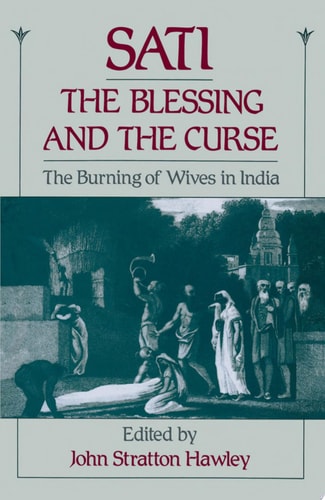
Sati, the Blessing and the Curse: The Burning of Wives in India
0
0
As an Amazon Associate and affiliate partner, Menrva Books earns from qualifying purchases. Learn more
Author Description
Several years ago in Rajasthan, an eighteen-year-old woman was burned on her husband's funeral pyre and thus became sati. Before ascending the pyre, she was expected to deliver both blessings and curses: blessings to guard her family and clan for many generations, and curses to prevent anyone from thwarting her desire to die. Sati also means blessing and curse in a broader sense. To those who revere it, sati symbolizes ultimate loyalty and self-sacrifice. It often figures near the core of a Hindu identity that feels embattled in a modern world. Yet to those who deplore it, sati is a curse, a violation of every woman's womanhood. It is murder mystified, and as such, the symbol of precisely what Hinduism should not be.In this volume a group of leading scholars consider the many meanings of sati: in India and the West; in literature, art, and opera; in religion, psychology, economics, and politics. With contributors who are both Indian and American, this is a genuinely binational, postcolonial discussion. Contributors include Karen Brown, Paul Courtright, Vidya Dehejia, Ainslie Embree, Dorothy Figueira, Lindsey Harlan, John Hawley, Robin Lewis, Ashis Nandy, and Veena Talwar Oldenburg.
Menrva's Summary
THE THESIS
This volume investigates the multifaceted cultural, religious, and political significance of the practice of sati within the context of Indian identity and global discourse. Editor John Stratton Hawley compiles a diverse collection of scholarly essays that examine the tension between sati as a symbol of ultimate devotion and as a manifestation of systemic violence. By integrating perspectives from Indian and American academics, the text provides a comprehensive framework for understanding how this ritual functions as both a traditional anchor and a point of intense modern controversy.
THE SCOPE MAP
What You Will Find
- Historical and sociological analysis of the practice of sati in Rajasthan and beyond.
- Interdisciplinary perspectives including literature, art, psychology, economics, and political science.
- A binational, postcolonial dialogue featuring contributions from leading scholars in the field.
- Examination of the symbolic role of sati in the construction of modern Hindu identity.
THE AUTHORITY PERSPECTIVE
Experts recognize this collection as a foundational interdisciplinary resource for understanding the complexities surrounding the ritual of sati. Readers frequently note the academic rigor and the balanced inclusion of diverse cultural viewpoints within the essays.
Page Count:
234
Publication Date:
1994-01-01
Publisher:
Oxford University Press, U.S.A.
ISBN-10:
0195360222
ISBN-13:
9780195360226
Religion
History
Sociology
India
Gender Studies
Asian History
Women india
Customs & Traditions
Hinduism
Community Tags
Similar Books