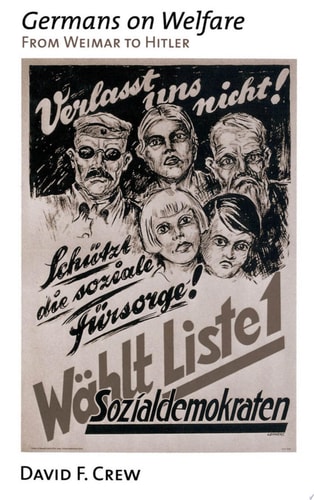
Germans on Welfare: From Weimar to Hitler
0
0
As an Amazon Associate and affiliate partner, Menrva Books earns from qualifying purchases. Learn more
Author Description
The welfare state was one of the pillars of the Weimar Republic. The Weimar experiment in democracy depended to no small degree upon the welfare system's ability to give German citizens at least a fundamental level of material and mental security in the face of the new risks to which they had been exposed by the effects of the lost war, revolution, and inflation. But the problems of the postwar period meant that, even in its best years, the Weimar welfare state was dangerously overburdened. The onset of the Depression and the growth of mass unemployment after 1929 destroyed republican democracy and the welfare state upon which it was based. On the ruins of Weimars social republic, the Nazis built a murderous racial state. Existing work on the Weimar welfare state concentrates largely on the discussions of social reformers, welfare experts, feminists, and the laws and institutions that their debates produced. Yet the Weimar welfare state was not simply the product of discourse and discursive struggles; it was also constructed and re-produced by the daily interactions of hard-pressed officials and impatient, often desperate clients. Adopting a "history of everyday life" perspective, Germans on Welfare: From Weimar to Hitler, 1919-1935 shows how welfare discourse and policy were translated into welfare practices by local officials and appropriated, contested, or re-negotiated by millions of welfare clients.
Menrva's Summary
THE THESIS
This book investigates how the Weimar Republic's welfare system functioned as a critical pillar of democratic stability and how its collapse during the Great Depression facilitated the rise of the Nazi racial state. David F. Crew, a historian specializing in modern German social history, utilizes a 'history of everyday life' methodology to move beyond high-level policy analysis. By examining the granular interactions between local bureaucrats and desperate citizens, he argues that the welfare state was defined as much by its practical implementation as by its legislative discourse. The text provides a comprehensive look at the transition from the social republic of the 1920s to the exclusionary policies of the early Third Reich.
THE SCOPE MAP
What You Will Find
- Analysis of the Weimar Republic's social welfare infrastructure from 1919 to 1935.
- Examination of the daily interactions between welfare officials and unemployed clients.
- Use of local administrative records and personal accounts to reconstruct social history.
- Exploration of how economic instability and mass unemployment undermined democratic institutions.
THE AUTHORITY PERSPECTIVE
Historians and scholars of the Weimar period frequently cite this work for its shift toward the lived experience of social policy rather than focusing solely on legislative history. The text is recognized as a foundational study for understanding the intersection of bureaucratic practice and political collapse in interwar Germany.
Page Count:
304
Publication Date:
2001-01-01
Publisher:
Oxford University Press USA
ISBN-10:
0195363922
ISBN-13:
9780195363920
History
Welfare state
Social History
Germany
Economics history
European History
Poor
German history
Community Tags
Similar Books